
1-805-484-2992
Quotes - Sizing - SalesOverview
Grow lights and solar gain both add heat a greenhouse or vertical farm has to remove on a schedule the crop sets, not the weather.
A greenhouse's cooling load comes from two directions at once - solar gain through the glazing and heat thrown off by supplemental lighting - and a fan-coil loop fed by a glycol chiller is what pulls that heat back out to hold the crop's target range. Because solar gain swings hard between a clear day and an overcast one, the loop has to be sized against peak simultaneous gain, not a seasonal average.
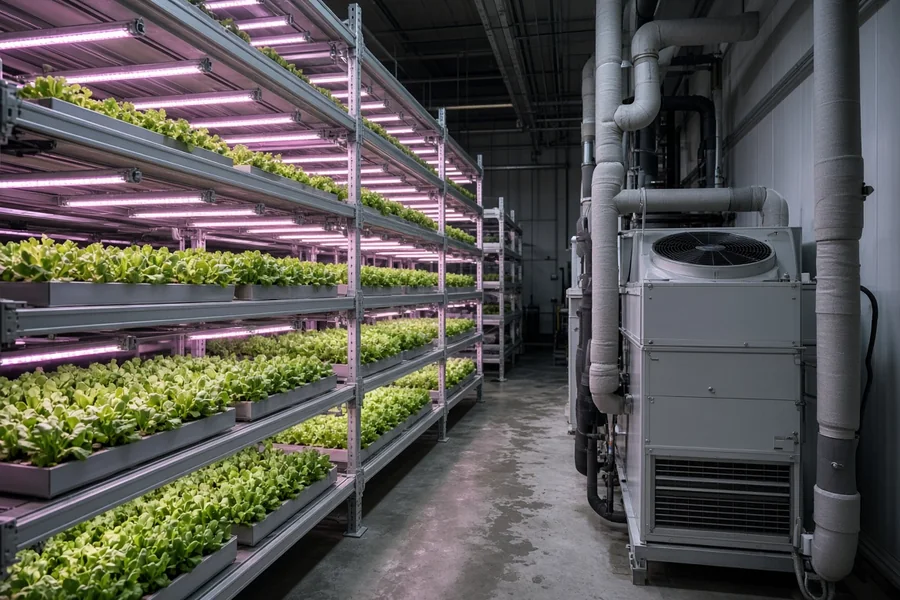
A sealed indoor vertical farm faces a related but distinct problem: nearly all of its heat load comes from grow lighting and equipment rather than the sun, and because the space is sealed rather than naturally ventilated, that heat has nowhere to go without mechanical cooling. Grow-room cooling loads scale directly with lighting wattage per square foot, which makes them more predictable to size than a greenhouse's weather-driven load, but no less real.
Both applications typically run a chilled or glycol water loop rather than direct refrigerant to the grow space, which keeps the cooling equipment itself out of the growing environment and simplifies service access.
- Greenhouse loads are sized against peak simultaneous solar gain, not a seasonal average
- Vertical farm grow-room load scales with lighting wattage per square foot
- A glycol water loop keeps cooling equipment out of the growing environment itself
Sizing Greenhouse & Vertical Farm Cooling
Greenhouse tonnage is driven by glazing area and peak solar gain for your latitude, plus any supplemental lighting load - it is not a simple square-footage rule of thumb. Vertical farm tonnage is more predictable: it scales almost directly with installed grow-light wattage per square foot, since the sealed room has no other significant heat path in or out.
Both applications commonly run a single packaged glycol chiller feeding a fan-coil (greenhouse) or grow-room air handler (vertical farm) loop, with the reservoir/pump skid sized for the loop's total flow rather than any single coil.
Send Us
- Glazing area or grow-room square footage
- Installed lighting wattage
- Target leaving fluid / room temperature
- Indoor or outdoor chiller placement
TYPICAL RANGES BY OPERATION
| Operation | Leaving Fluid Temp | Load Profile | Typical Glycol Mix |
|---|---|---|---|
| Greenhouse fan-coil | 40-50°F | Weather-driven, day peak | 20-25% propylene |
| Vertical farm grow room | 45-55°F | Steady, lighting-cycle driven | 15-20% propylene |
| Combined grow + equipment room | 35-45°F | Mixed, continuous baseline | 20-30% propylene |
Ranges are typical starting points, not a substitute for a load calculation - actual leaving fluid temperature and glycol percentage depend on your glazing, lighting and local climate.
Call and talk it through with an engineer: 1-805-484-2992.