
1-805-484-2992
Quotes - Sizing - SalesOverview
A server room can lose equipment to heat in minutes, not hours - a staged portable chiller is what buys time during an outage, repair or expansion.
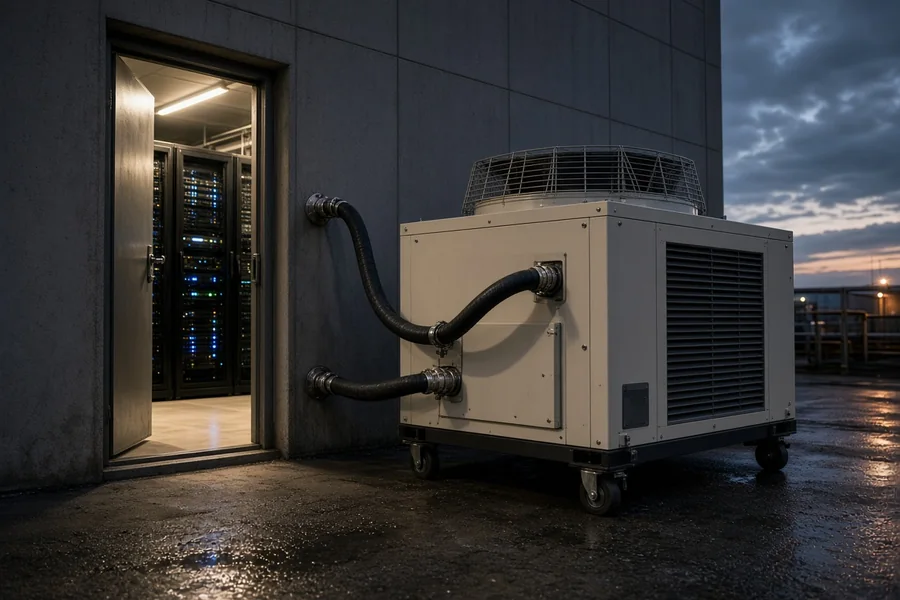
A server room's cooling system going down - whether from equipment failure, a planned upgrade, or a facility expansion that's outgrown existing capacity mid-project - puts IT equipment at risk within minutes, not hours, since rack heat loads climb fast without active cooling. A portable glycol chiller staged as a temporary bridge, connected through hose or quick-connect fittings, keeps a room within its safe operating range until the permanent system is repaired, upgraded or brought fully online.
Because this is typically a short-notice, temporary deployment, sizing works from the room's existing or planned rack heat load rather than a from-scratch calculation, and the connection method matters as much as raw capacity - a unit that takes a full day to plumb in defeats the purpose when a server room is already running hot.
IT and facilities teams that know an expansion or a chiller-plant upgrade is coming are better served arranging temporary cooling capacity ahead of the work than sourcing it after equipment has already started shutting down on thermal protection.
- Rack heat loads climb fast without active cooling - minutes matter, not hours
- Sizing works from existing or planned rack load, not a from-scratch calculation
- Planning temporary capacity ahead of a known expansion or upgrade beats sourcing it mid-emergency
Sizing Temporary & Emergency Server Room Cooling
The fastest number to work from is the room's existing chiller nameplate tonnage, if there is one - a staged replacement unit matched to that number gets equipment protected without a full load recalculation under time pressure. Where no nameplate exists, current rack kW draw is the next-best number.
Connection method matters as much as capacity for an emergency deployment - confirm in advance whether the staged unit needs to tie into existing CRAC/CRAH piping, or whether portable air-handling accompanies the chiller, so the actual hookup doesn't become the bottleneck during an outage.
Send Us
- Existing chiller tonnage or current rack load (kW)
- How long the temporary/emergency cooling is needed
- Connection point (existing piping vs. portable air handling)
- Site access and available voltage
TYPICAL RANGES BY SCENARIO
| Scenario | Leaving Fluid Temp | Load Profile | Typical Glycol Mix |
|---|---|---|---|
| Planned chiller swap/repair bridge | 42-50°F | Continuous, matched to existing unit | 20-30% propylene |
| Unplanned outage / emergency | 42-50°F | Continuous, rack-load driven | 20-30% propylene |
Ranges are typical starting points, not a substitute for a load calculation - actual leaving fluid temperature and glycol percentage depend on your existing system's setpoint and rack load.
Call and talk it through with an engineer: 1-805-484-2992.