
1-805-484-2992
Quotes - Sizing - SalesThe Widest Choice of Formats
The range most breweries, wineries, food lines and molding shops land in - indoor or outdoor, air- or water-cooled.
Between 5 and 40 tons a glycol load can be met four ways: a large portable beside the process, an indoor chiller with its condenser moved outdoors, a small central chiller with a big tank, or a packaged unit on a pad outside the building. All four exist at almost every size in this range, so the choice turns on floor space, where the heat can go and how the load will grow.
Sixty-six of the Temptek units we supply are rated from 5 to 40 tons at 50°F. Forty-two of them are complete packaged chillers with their own tank and pump, split between the Indoor Packaged Units and Outdoor Packaged Units pages. The other twenty-four are MA and MW chilling modules, which connect to a tank and pump station supplied separately.
Indoor or Outdoor Decides Most of It
An indoor unit keeps the compressors and controls in a heated, serviceable room and puts either the whole chiller or only its condenser in the plant. An outdoor packaged unit takes the refrigeration plant out of the building entirely: condenser, compressors, tank and pumps arrive as one package on a pad, and only the supply and return lines come inside. The outdoor units are designed to run in ambient air from -20°F to 95°F, which is what makes them practical through a cold-climate winter.
Condensing is the other fork. An air-cooled portable indoors puts the load plus its compressor heat into the room; a remote condenser (the CG-ARC and TTI air-cooled units) sends it outdoors through a pair of refrigerant lines; a water-cooled unit sends it to tower or city water. Water-cooled units need the most infrastructure and hold their capacity best on a hot day.
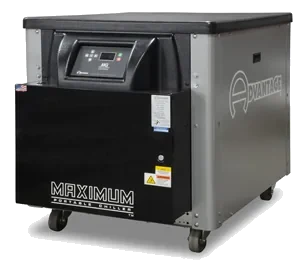
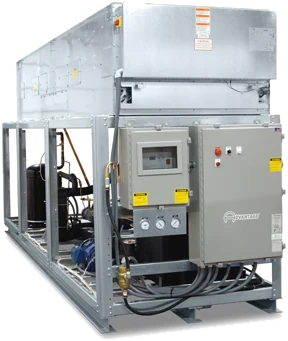
SERIES FROM 5 TO 40 TONS
| SERIES | FORMAT | CONDENSER | TANK & PUMP | MODELS | RATED TONS (50°F) |
| CG Air-Cooled | Portable | Air-Cooled | Included | 10 | 7.2 - 29 |
| CG Water-Cooled | Portable | Water-Cooled | Included | 8 | 5.1 - 40 |
| CG-ARC | Indoor, remote condenser | Remote Air-Cooled | Included | 7 | 7.1 - 36.7 |
| TTI Air-Cooled | Central, remote condenser | Remote Air-Cooled | Included | 3 | 20.5 - 40 |
| TTI Water-Cooled | Central | Water-Cooled | Included | 3 | 20.5 - 40 |
| MA Modules | Chilling module | Remote Air-Cooled | Separate | 12 | 5 - 38 |
| MW Modules | Chilling module | Water-Cooled | Separate | 12 | 5 - 38 |
| TTOACS | Outdoor package | Air-Cooled | Included | 11 | 5.3 - 38.4 |
Sizing in the 5 to 40 Ton Range
Most loads that land here are several process points on one loop: a cellar of fermenters and brite tanks, a row of molding presses, a line of jacketed kettles. Size the chiller for the peak of the combined load at the supply temperature the coldest point needs - usually a crash or a pull-down, not the steady hold.
Rated at 50°F, Selected at Your Setpoint
Every unit in this range is rated at 50°F leaving water, and the central, modular and outdoor units publish the multipliers for colder duty: 0.80 at 40°F, 0.60 at 30°F and 0.40 at 20°F. A brewery holding 28°F glycol on a TTOACS-40S-CG-1P gets about 21 tons from a 38.4-ton rating, not 38.
A brewery example
Ten 30-barrel fermenters, one crashing from 68°F to 34°F each day over 24 hours: the crash alone is about 11,300 BTU/hr, close to a ton. Add the heat of active fermentation on the other tanks, the brite tanks' hold load and the heat the glycol picks up in its lines, and size the total at the 28°F supply. At that setpoint the 50°F rating you select is about 1.8 times the load (1 divided by 0.56).
Leave room for the next tank
Loads in this range grow. A TTI central chiller can be configured for future expansion, and an MA or MW module can be added to an existing tank and pump station later. A portable sized exactly to today's load is the least flexible choice when the next fermenter or press is already on the plan; the sizing guide walks through the load calculation in the order we ask about it.
Call and talk it through with an engineer: 1-805-484-2992