
1-805-484-2992
Quotes - Sizing - SalesOverview
Active fermentation is exothermic - the tank makes its own heat, and the glycol jacket has to pull it back out fast enough to keep the yeast in range.
As yeast converts sugar to alcohol and CO2, a fermenter generates heat on its own, and left alone, tank temperature climbs past what most yeast strains tolerate. A glycol solution circulated through the tank's cooling jacket pulls that heat out and holds the batch inside its fermentation profile - typically a tighter window during active fermentation than during cold-crash or cellar holding afterward.
Because fermentation heat load rises and falls through the batch, the chiller and glycol loop need to be sized for peak heat rejection during active fermentation, not an average across the whole cycle. Most breweries run several jacketed fermenters and bright tanks off one shared glycol loop and reservoir rather than a chiller per vessel, which is where a central or add-on packaged glycol system earns its keep over several small portables.
Cellar holding after fermentation is a lighter, steadier load - keeping bright tanks and conditioning space at a constant temperature rather than pulling active fermentation heat - but it still runs off the same glycol loop and needs to be counted into the total tonnage.
- Jacketed fermenter cooling holds yeast temperature through an exothermic ferment
- Peak heat load during active fermentation, not average load, sizes the loop
- Shared glycol loops commonly serve multiple fermenters and bright tanks from one chiller
- Cellar/conditioning holding is a steady, lower load on the same loop
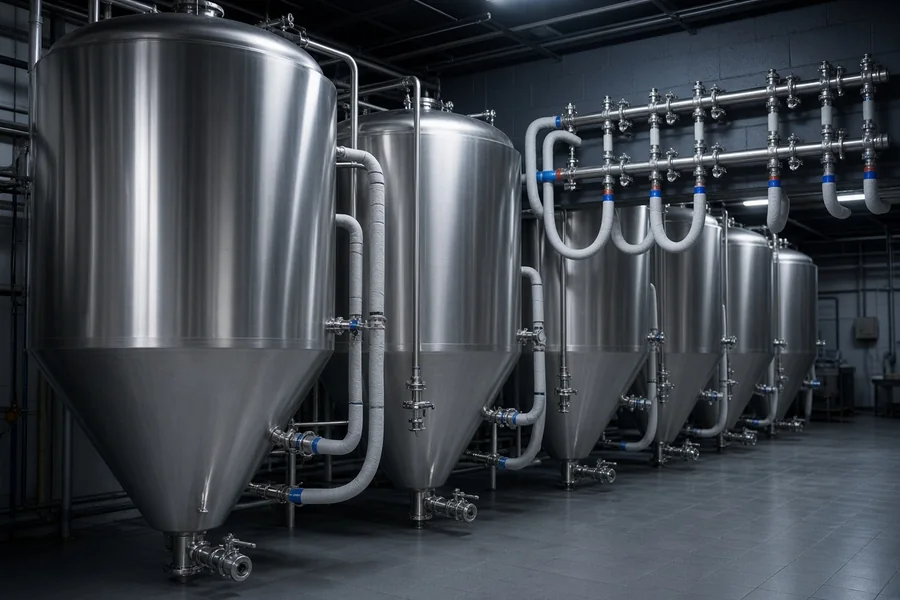
Sizing Brewery Fermentation & Cellar Cooling
Active fermentation is the peak load: a fermenter making its own heat needs the jacket to pull it out fast enough to hold the yeast's temperature range, and that peak - not the idle load between batches - is what sizes the chiller. Cellar and bright-tank cooling is a steadier, lower-intensity load layered on top of it.
Most breweries run fermentation and cellar cooling from one glycol loop, with the pump/reservoir sized for worst-case overlap - several fermenters in active cooling at once while cellar tanks hold steady. Where batch schedules are staggered deliberately, that overlap can be smaller than a worst-case count of vessels would suggest.
Send Us
- Fermenter volume and count
- Target fermentation and cellar temperatures
- Typical amount of vessels cooling simultaneously
- Indoor or outdoor installation
TYPICAL RANGES BY DUTY
| Duty | Leaving Fluid Temp | Load Profile | Typical Glycol Mix |
|---|---|---|---|
| Active fermentation | 28-34°F | Batch, high peak | 30-35% propylene |
| Cellar / bright tank holding | 30-36°F | Continuous, moderate | 25-30% propylene |
| Cold crash | 28-32°F | Batch, short high peak | 30-35% propylene |
Ranges are typical starting points, not a substitute for a load calculation - actual leaving fluid temperature and glycol percentage depend on your vessel count, schedule and recipe.
Call and talk it through with an engineer: 1-805-484-2992.