
1-805-484-2992

Quotes - Sizing - Sales

210+ Ton Glycol Chiller Systems

Plant-wide glycol loops built from several units

Request a Quote

Above 210 Tons, the Plant Is the Product

Plant-wide glycol loops built from several units: modular, add-on and multi-zone systems sized to the whole site.

No single chiller in the line we supply is rated above 188 tons at 50°F, and at a typical 28°F glycol setpoint that is about 105 tons of real capacity. A plant that needs more is built from several units working on one loop, and the engineering moves from picking a model to laying out a plant: how many units, how they share the load, and what the plant does when one is down.

Two pages cover it. Dual-Zone & Multi-Zone Chillers covers the units that split their capacity across two or three refrigeration zones, and plants that run separate loops at separate temperatures. Add-On & Plant-Wide Systems covers MA and MW modules and central chillers combined on a common header.

How Large Glycol Plants Are Built

The usual arrangement is two or more chillers, each with its own tank or connected to a shared one, feeding a common supply header, with distribution pumps serving the process points. A plant controller stages units on and off as the load changes and rotates which one leads, so run hours stay even across the plant.

Separate temperatures get separate loops. A brewery that crashes at 28°F and also cools process water at 45°F runs two loops, each with its own chiller or group of chillers; it does not ask one loop to do both. The two can still share a mechanical room, a tower and a controls system.
In This Range

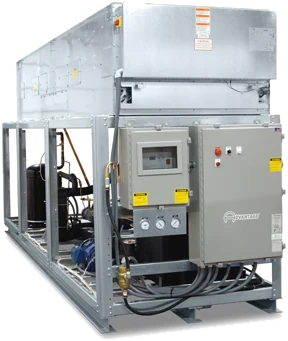
Outdoor packaged glycol chiller, representative unit

Dual-Zone / Multi-Zone Chillers:

Two and Three Refrigeration Zones

  • 18 part numbers
  • 20.2 to 188 tons each
  • TTI and TTOACS
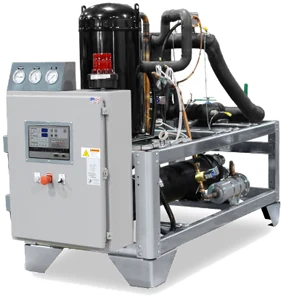
Water-cooled chilling module, representative unit

Add-On & Plant-Wide Systems:

Modules on a Common Header

  • 22 part numbers
  • 60 to 180 tons each
  • MA and MW modules

COMBINED RATINGS AT 50°F

UNIT SERIES RATED TONS (50°F) TWO UNITS THREE UNITS FOUR UNITS
TTI-120W TTI Water-Cooled 127.8 255.6 383.4 511.2
TTI-180W TTI Water-Cooled 180 360 540 720
TTOACS-210D-MZC-2P TTOACS 188 376 564 752
MW-120-CCC MW Modules 120 240 360 480
MW-180-CCC MW Modules 180 360 540 720
MA-180-RC-CCC MA Modules 180 360 540 720
752 tons
four of the largest outdoor units combined
890 tons
50°F rating for a 500-ton load at 28°F
N+1
enough units for the load, plus a spare
22
MA and MW add-on module part numbers

Planning a Plant Above 210 Tons

Start with the load profile, not just the peak: how many hours a year the plant runs near peak, what the minimum load is at night or on a weekend, and which loads must never stop. A plant that runs at 30% of design for half the year needs units small enough that one of them can carry that load on its own without cycling.

Redundancy Sets the Unit Count

Size the plant so it carries the design load with its largest unit out of service - the N+1 arrangement. A 400-ton design load at 50°F built from 180-ton units takes three units to carry it and a fourth to cover one down.

Setpoint first

Every rating here is at 50°F. At 28°F glycol a 500-ton design load needs about 890 tons of 50°F rating - five of the largest outdoor units, or six with one spare.

Mixing unit types

Plants often combine types: water-cooled TTI chillers in the mechanical room where tower water is available, and outdoor TTOACS packages added later in the yard as the plant grows. The common header makes the unit type invisible to the process, as long as each unit's controls are tied into the plant controller.

Call and talk it through with an engineer: 1-805-484-2992

Request a Quote

Plants Above 210 Tons: Questions Buyers Ask

Three units. A 300-ton load at 28°F needs about 534 tons of 50°F rating, and three TTOACS-210D-MZC-2P packages give 564 while three TTI-180W chillers give 540. The ratio comes from this page's own figure of about 890 tons for a 500-ton load, roughly 1.78 to 1. Three TTI-180Ws clear the target by only 6 tons, which is thin once condenser fouling and a hot summer are counted; the three outdoor packages leave about 30. Neither set covers a unit down. Holding 300 tons at 28°F with one unit out takes a fourth unit, which puts the plant at 720 or 752 tons of rating.

About 420 tons with all four running, and about 315 with one of them down. The combined table gives 752 tons of 50°F rating for four TTOACS-210D-MZC-2P packages and 564 for three; dividing by the same 1.78 that turns 890 tons of rating into a 500-ton load gives the cold-loop figures. So a four-package yard is a firm 300-ton plant at 28°F, not a 500-ton one, an easy slip to make at the planning stage. A 500-ton cold loop needs five packages, and six to stay firm.

Not necessarily. Matching sizes keeps lead rotation and spare parts simple, but one smaller unit often runs the plant better through light-load hours. Take a 500-ton design at 50°F with a weekend load of 30%, about 150 tons. Any 180-ton unit on the combined table carries that alone, so a plant of TTI-180W or MW-180-CCC units already handles it, as does one built from 188-ton outdoor packages. The case for mixing comes when the light load falls well below one large unit's lowest stable step: then a TTI-120W at 127.8 tons, or a smaller module, covers nights and weekends while the large units stay off. If sizes are mixed, have the controller rotate within each size group, or the small unit piles up the hours.

Modules suit a plant that wants one shared tank and pump station; complete TTI chillers suit one that wants every unit self-contained. Ratings run close. Four MW-120-CCC modules give 480 tons at 50°F against 511.2 for four TTI-120W chillers, and at 180 tons the MW-180-CCC and TTI-180W match exactly, 720 tons for four of either. The real diffrence is the distribution. With modules, the tank, pumps and header are one engineered system, sized once for the final plant, and a fault there can reach every module unless standby pumping is built in. With TTI units, each chiller carries its own tank and pump, so a pump fault takes out one unit, but the plant has several tanks to keep balanced on the header.

The plant's own engineer or mechanical contractor designs the header, the distribution pumps and the plant controls, and we work with them on the refrigeration side: unit count, sizes, setpoints and how each unit ties into the controller. Bring the load profile to the first conversation, not only the peak. The night and weekend minimum sets the smallest unit, the loads that can never stop set the spare, and hours near peak show how hard the plant works. With those three, an application specialist can propose a layout before anyone draws pipe.

Yes, provided the header, distribution pumps and electrical service are built for the finished plant on day one. A site might start with two TTI-180W chillers, 360 tons at 50°F, and add a third for 540 when the load arrives, with that unit's header connections already valved and capped. TTI chillers can be ordered set up for later expansion, and MA or MW modules hang off the shared tank. What can't be added cheaply later is pipe and power: a header or switchgear sized for the first two units turns the third into a shutdown project.

Quote Request Form:

Questions?

1-805-484-2992

Quotes - Sizing - Sales