
1-805-484-2992
Quotes - Sizing - SalesOverview
A dairy plant runs several cooling duties on one clock - pasteurizer cooldown, vat jacketing and cold storage all have to hit their setpoints on schedule.
Raw milk and finished dairy product both have narrow, food-safety-driven temperature windows: a plate-and-frame pasteurizer has to drop product through the danger zone within a set time, and a jacketed cheese or yogurt vat has to hold a steady set-cooling temperature through the culture or set process. Both duties are commonly served by the same glycol loop, sized for whichever draws the larger simultaneous load.
Cold storage - raw milk silos, finished product coolers, aging rooms - is a steadier, lower-intensity load layered on top of process cooling, but it still needs to be counted into total tonnage, since it runs continuously rather than in the batch cycles that drive pasteurizer and vat demand.
Glycol is the standard fluid here rather than plain water because dairy process setpoints frequently run below what a water loop can hold without risking freeze-up in the chiller's own heat exchanger, and because one glycol loop can typically serve several different dairy duties at once from a single packaged system.
- Pasteurizer cooldown has to clear the food-safety danger zone within a set time
- Jacketed vat cooling holds a steady setpoint through culturing or setting
- Cold storage is a continuous, lower-intensity load layered on top of process cooling
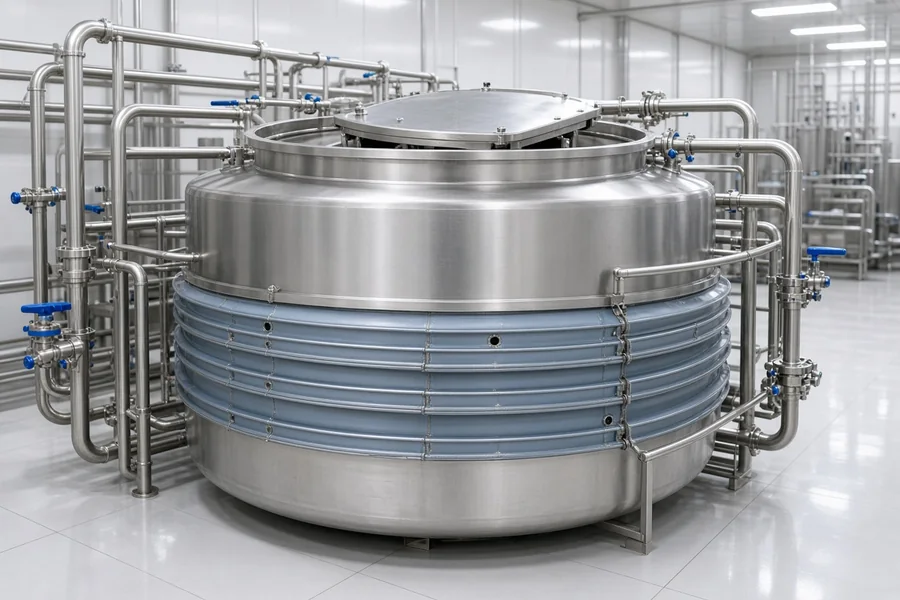
Sizing Dairy Processing & Storage Cooling
Pasteurizer and vat-jacket duty are batch loads - they spike hard for a defined window and idle between runs - while cold storage is a flat, continuous draw. Total tonnage has to cover the worst-case overlap: the busiest pasteurizer run landing while the vats are still cooling and the storage load is holding steady, not the average across a shift.
A single packaged glycol chiller commonly serves all three duties from one loop, with the pump/reservoir skid sized for the combined peak flow rather than any one duty alone. Where a plant's pasteurizer and vat schedules never overlap, splitting the load across two smaller units instead of one large one can also make sense - worth flagging when you send us the schedule.
Send Us
- Pasteurizer throughput and cooldown time target
- Vat volume and jacket area, if applicable
- Cold storage square footage and setpoint
- Whether duties run on overlapping or separate schedules
TYPICAL RANGES BY DUTY
| Duty | Leaving Fluid Temp | Load Profile | Typical Glycol Mix |
|---|---|---|---|
| Pasteurizer cooldown | 28-34°F | Batch, high peak | 30-35% propylene |
| Vat jacket cooling | 32-38°F | Batch, moderate peak | 25-30% propylene |
| Cold storage / aging room | 36-40°F | Continuous, flat | 20-25% propylene |
Ranges are typical starting points, not a substitute for a load calculation - actual leaving fluid temperature and glycol percentage depend on your specific process setpoints, ambient conditions and line pressure drop.
Call and talk it through with an engineer: 1-805-484-2992.