
1-805-484-2992
Quotes - Sizing - SalesOverview
A cooling tunnel or enrober line has to pull heat out fast enough to set the product before it reaches packaging - too slow and the line backs up.
A baked or confectionery product coming off the oven or enrober carries a lot of latent heat, and a cooling tunnel has to pull that heat out on a fixed line speed - not on its own schedule. A glycol loop feeding the tunnel's cooling coils gives a lower, more consistent supply temperature than plant chilled water, which is what lets the tunnel hold its rated throughput without the product arriving at packaging still warm.
Confectionery enrober lines add a second consideration: the chocolate or coating itself has a working temperature range that's easy to overshoot, so the glycol supply temperature has to be tuned to the product, not just to "as cold as possible." Running the loop too cold can crack a coating as readily as running it too warm can leave it soft.
Because bakery and confectionery lines typically run one or two shifts with fixed throughput, sizing is usually straightforward once the line speed and product heat load are known, and a packaged portable or outdoor glycol chiller is the common fit for a single line or a small plant.
- Cooling tunnel duty is set by line speed, not an average cooling rate
- Enrober coating temperature has a working range on both the warm and cold side
- Fixed shift throughput makes sizing straightforward from line speed and product heat load
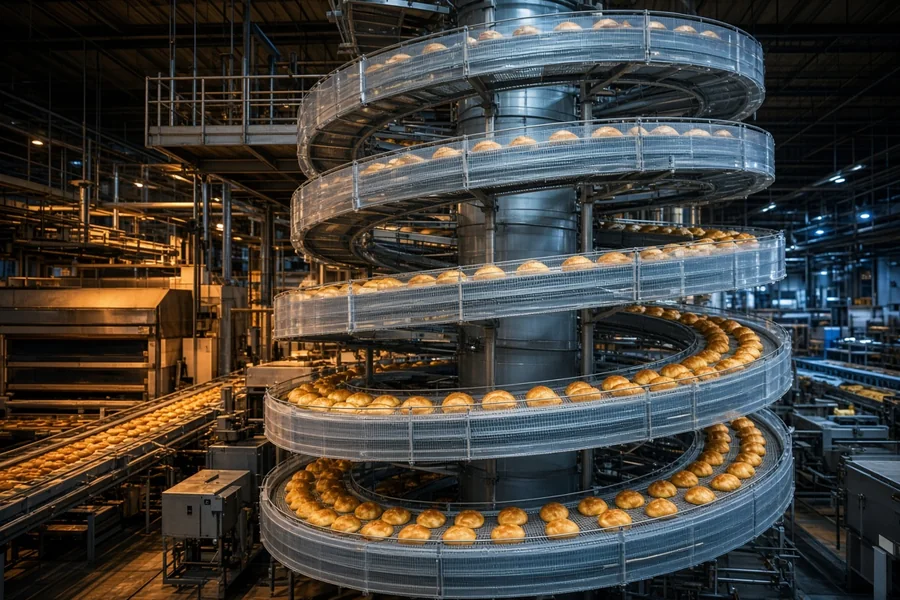
Sizing Bakery & Confectionery Cooling
Cooling tunnel and enrober load is set by line speed and product mass, not oven output - the tunnel has to remove enough heat per minute to set the product before it reaches packaging at whatever throughput the line runs. Running the line faster without adding tunnel capacity is the most common way a bakery outgrows its chiller.
Most single-line bakery or confectionery duty runs a dedicated glycol chiller feeding the tunnel or enrober cooling jacket directly, sized for the coldest zone's temperture and the tunnel's total heat rejection at rated line speed.
Send Us
- Line speed and product throughput
- Tunnel or enrober coldest-zone temperature
- Number of cooling zones
- Indoor or outdoor installation
TYPICAL RANGES BY DUTY
| Duty | Leaving Fluid Temp | Load Profile | Typical Glycol Mix |
|---|---|---|---|
| Cooling tunnel, coldest zone | 20-30°F | Continuous, line-speed driven | 30-35% propylene |
| Enrober cooling jacket | 45-55°F | Continuous, moderate | 20-25% propylene |
Ranges are typical starting points, not a substitute for a load calculation - actual leaving fluid temperature and glycol percentage depend on your product, line speed and tunnel zoning.
Call and talk it through with an engineer: 1-805-484-2992.