
1-805-484-2992

Quotes - Sizing - Sales

Compressor & Hydraulic Oil Cooling

Air Compressor & Hydraulic Power Unit Cooling

Overview

A compressor or hydraulic power unit that runs hot loses efficiency long before it fails outright - the cooling loop is what keeps it in its rated window.

Compressing air generates heat as a direct byproduct, and an air compressor's aftercooler has to remove that heat to deliver air at a usable temperature and to protect the compressor itself from running outside its rated range. A glycol loop feeding the aftercooler gives a consistent supply temperature regardless of outdoor ambient conditions, which matters most on compressors that have to hold rated output year-round.

Hydraulic power units carry a related but distinct load: hydraulic oil heats up under working pressure, and oil that runs too hot loses viscosity and accelerates wear on seals and pumps. A glycol-cooled heat exchanger on the hydraulic reservoir holds oil temperature inside its rated band regardless of duty cycle, which is a real factor in equipment life, not just short-term performance.

Both duties are continuous-run loads rather than batch cycles, which makes them straightforward to size once the equipment's rated heat rejection is known - usually published by the compressor or hydraulic unit manufacturer rather than something we need to estimate.

  • Aftercooler duty holds compressed air output temperature and protects the compressor itself
  • Hydraulic oil cooling protects viscosity and seal/pump life, not just short-term performance
  • Both are continuous-run loads sized from the equipment's own published heat rejection rate
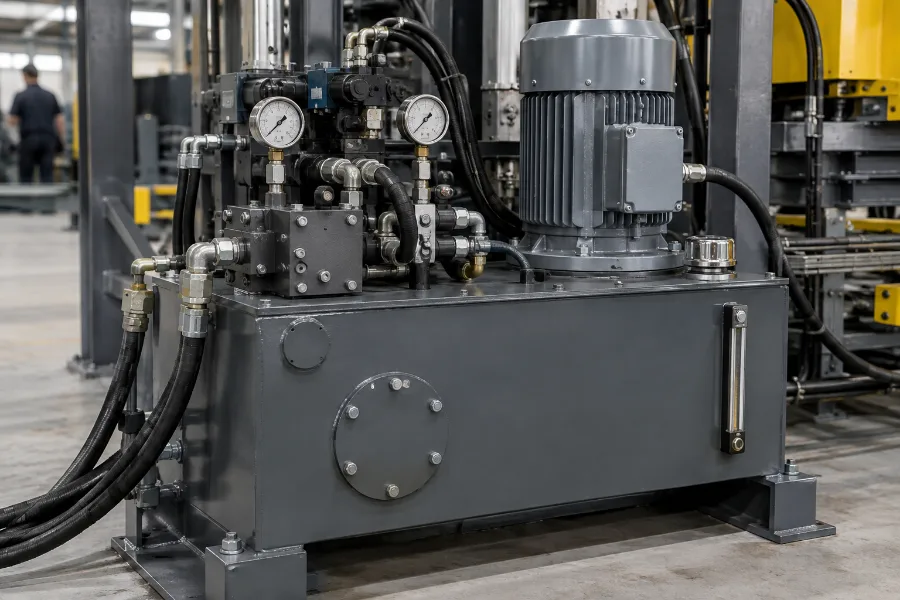
Hydraulic power unit with oil reservoir, pump motor and gauges
A hydraulic power unit typically wants 60-75°F fluid at its oil heat exchanger. Size it from the nameplate heat rejection, not an estimate.
Rotary screw compressor
50-65°F
Hydraulic power unit
60-75°F
Glycol mix
25-35% ethylene
Size from
Nameplate BTU/hr or kW

Sizing Compressor & Hydraulic Oil Cooling

Rated heat rejection off the equipment's own nameplate is the fastest path to a correct size - a rotary screw compressor or hydraulic power unit publishes a BTU/hr or kW rejection figure that maps almost directly to chiller tonnage, without a separate load calculation.

Duty cycle matters more here than in most applications: equipment that runs continuously at full load needs the nameplate number covered without derating, while equipment that cycles or runs at partial load most of the time has some real margin to work with.

Send Us

  • Equipment make/model or nameplate heat rejection
  • Duty cycle (continuous vs. intermittent)
  • Required oil/fluid outlet temperature
  • Indoor or outdoor installation

TYPICAL RANGES BY EQUIPMENT

EquipmentLeaving Fluid TempLoad ProfileTypical Glycol Mix
Rotary screw air compressor50-65°FContinuous, steady25-35% ethylene
Hydraulic power unit60-75°FContinuous, load-cycling25-35% ethylene

Ranges are typical starting points, not a substitute for the equipment manufacturer's rated heat rejection figure - actual leaving fluid temperature and glycol percentage depend on your specific unit and duty cycle.
Call and talk it through with an engineer: 1-805-484-2992.


Compressor and Hydraulic Oil Cooling: Sizing Notes

The hottest air its condenser will actually draw in - the peak summer temperature outdoors, or the real temperature of the compressor room if it sits indoors. A chiller's capacity falls as the air across its condenser gets hotter, and compressor rooms run warm because the compressors reject heat in to them. A unit rated at a mild nominal condition can look fine in spring and then let the aftercooler supply drift upward on summer afternoons, which is exactly when the compressor works hardest and that drift does the most harm.

Because the oil temperature is the process target and the glycol temperature is only the means to it; the gap between them is what sizes the heat exchanger on the reservoir. Hot oil must give up its heat to colder glycol, and the closer the two temperatures are, the larger the exchanger has to be for the same duty. The common error is sending the oil limit as the chiller setpoint: the chiller gets selected at that temperature, the glycol arrives as warm as the oil should be, and the oil settles above its band. Over months that shows up as seal leaks and pump wear rather than an alarm. A hydraulic power unit typically takes 60-75°F leaving fluid; give us the oil outlet temperature the unit needs, and we will set the fluid against it.

Usually, yes: screw compressor and hydraulic unit manufacturers publish heat rejection, so a make and model lets us look up the figure. Send the full model string from the data plate, not just the series name, since rejection differs between sizes in one family. Also flag changes since the unit left the factory - a replaced motor, a new operating pressure, a pump upsized for a new press - because the published figure no longer fits the machine.

At the low end when the chiller and every pipe stay indoors in heated space, and toward the high end when the chiller sits outdoors or piping crosses an unheated area. The band is a starting point; the coldest temperature any part of the loop is exposed to sets the final figure. Extra glycol is not free: each percentage point above what freeze protection needs lowers heat transfer and raises pump load, so an indoor loop mixed for an outdoor winter carries a small, permanent capacity penalty. The opposite mistake, a lean mix in an outdoor chiller, shows up only on the coldest night, usually as a frozen evaporator. Tell us the installation location so the mix is set for it.

Quote Request Form:

Questions?

1-805-484-2992

Quotes - Sizing - Sales