
1-805-484-2992
Quotes - Sizing - SalesSmall Loads, Complete Units
Bench-top, lab, tasting-room and single-press loads: fractional plug-in units and three-phase portables, each with its own tank and pump.
Below 5 tons almost every glycol chiller we supply is a self-contained portable: compressor, condenser, reservoir, process pump and controls in one cabinet, delivered ready to pipe to the load. The decision in this range is rarely the format. It is the electrical supply the unit has to run on, the leaving temperature it has to hold, and whether the room it sits in can absorb the heat it rejects.
We supply the Temptek line new, and thirteen of its published part numbers fall under 5 tons at the 50°F rating point: six single-phase CF units from 0.29 to 1.5 tons, six three-phase CG portables from 2 to 4.9 tons (four air-cooled, two water-cooled), and one indoor chiller with a remote condenser, the CGD-5A-RC.
Where the Line Falls at 1.5 Tons
The split in this range is electrical before it is thermal. Every unit up to 1.5 tons runs on single-phase power - 115V on the four smallest CF models, 230V on the CF-1A and CF-1.5A - so it can go wherever a suitable branch circuit can be run. From 2 tons up the CG portables need three-phase power at 230V or 460V, and from 4 tons 575V is offered as well. A site with no three-phase service tops out at 1.5 tons from a single chiller.
Setpoint is the second filter. Every model is rated at 50°F leaving water, and capacity falls below that. The central and outdoor units in the larger ranges publish the multipliers - 0.80 at 40°F, 0.60 at 30°F, 0.40 at 20°F - and the portables lose capacity below 50°F in the same direction. We confirm the rating at your setpoint before quoting, so size from the setpoint, not the nameplate.
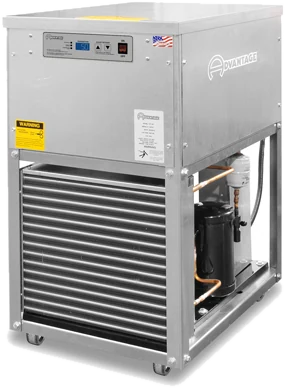
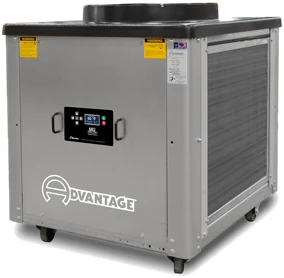
SERIES UNDER 5 TONS
| SERIES | FORMAT | CONDENSER | TANK & PUMP | MODELS | RATED TONS (50°F) |
| CF | Portable | Air-Cooled | Included | 6 | 0.29 - 1.5 |
| CG Air-Cooled | Portable | Air-Cooled | Included | 4 | 2 - 4.9 |
| CG Water-Cooled | Portable | Water-Cooled | Included | 2 | 2 - 3 |
| CG-ARC | Indoor, remote condenser | Remote Air-Cooled | Included | 1 | 4.9 |
Sizing a Small Glycol Load
Small loads are easy to under-size because each one looks trivial on its own, so add them up. A jacketed 7-barrel fermenter crashing from 68°F to 34°F over 24 hours sheds about 2,600 BTU/hr of sensible heat - roughly a fifth of a ton. A cellar of six of them crashing on the same day is over a ton, before the glycol lines, a warm tasting-room ambient and active fermentation on the other tanks are counted.
A Ton Is 24 GPM-Degrees
With water, one ton of cooling is 24 gallons per minute through a 1°F temperature change - or 2.4 GPM through 10°F. That is why the pumps on these units are sized at about 2.4 GPM per ton: a CF-1A moves 2.4 GPM and a CGD-5A 12 GPM. A load that needs a much tighter temperature rise than 10°F needs more flow than the built-in pump gives, and that changes the selection.
Check the room, not just the load
Every air-cooled unit in this range rejects its heat into the room it stands in - the load plus the compressor's own power. CF units are rated at 90°F ambient and the CG portables at 95°F, with 60°F as the minimum recommended ambient for both. A closet with no ventilation can pass 95°F within hours of start-up, and the chiller loses capacity just when the load peaks. Where the room cannot take the heat, the water-cooled CG-2W and CG-3W move it into plant or tower water instead.
Glycol protects the loop; it does not add capacity
The minimum recommended leaving temperature without glycol is 48°F. Below that the loop needs an inhibited glycol mix with a freeze point at least 10°F below the coldest fluid temperature it will see - propylene for food and beverage, ethylene where toxicity is not a concern. Glycol carries a little less heat per gallon than water, so the flow and the chiller are both checked at the mix you choose; the glycol type and mix guide covers the choice.
Call and talk it through with an engineer: 1-805-484-2992