
1-805-484-2992
Quotes - Sizing - SalesOverview
Equipment mounted outdoors - on a roof, a pad, or a yard - needs a chiller package built for the same exposure, not an indoor unit pressed into outdoor service.
Equipment that lives outdoors - rooftop-mounted process gear, a yard-mounted skid, a pad-mounted enclosure - needs cooling delivered by a chiller package that's actually rated for that exposure: weatherproof cabinet, cold-weather start capability, and a glycol mix sized to the site's real winter low, not just summer cooling duty. A unit built for an indoor mechanical room pressed into outdoor service is a common and avoidable failure point.
Because the cooling load on this kind of equipment often runs alongside a wide swing in outdoor ambient temperature - hot midday sun on a black rooftop, well below freezing overnight in winter - sizing has to account for both ends of that range, not just the peak summer condition most load calculations default to.
Outdoor packaged glycol chillers built for rooftop or yard mounting are the standard fit here, sized to the specific equipment's heat rejection requirement and the site's ambient extremes together.
- Outdoor-rated packaging (weatherproof cabinet, cold-weather start) is not optional for this duty
- Glycol mix is set by the site's real winter low, not just summer cooling load
- Sizing accounts for both peak-heat and peak-cold ambient conditions, not just summer peak
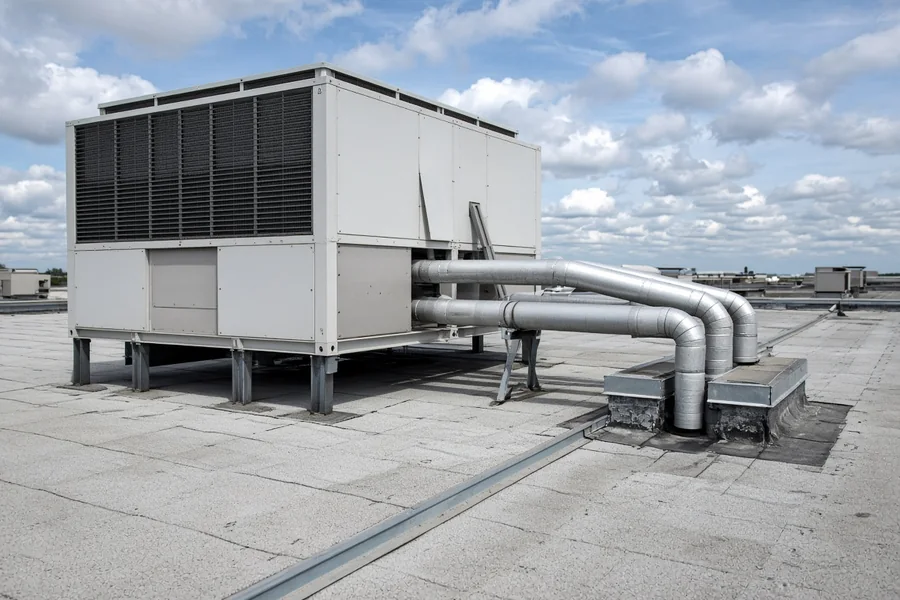
Sizing Rooftop & Outdoor Equipment Cooling
The equipment being served sets the heat load and required fluid temperature the same way it would indoors - what changes outdoors is the cabinet, controls and glycol mix, which all have to tolerate roof-level wind exposure and the site's full seasonal ambient range, not a sheltered equipment-room environment.
Rooftop placement adds structural and rigging considerations a ground-mounted or indoor unit doesn't have - curb weight limits, crane access and roof penetration all factor into which package actually fits the site, beyond tonnage alone.
Send Us
- Equipment heat load or required fluid temperature
- Roof structural/weight limits, if rooftop-mounted
- Coldest ambient design temperature at the site
- Crane or rigging access for installation
TYPICAL RANGES BY PLACEMENT
| Placement | Leaving Fluid Temp | Load Profile | Typical Glycol Mix |
|---|---|---|---|
| Rooftop-mounted package | 40-55°F | Continuous, equipment-driven | 25-35% ethylene or propylene |
| Yard-mounted package | 40-55°F | Continuous, equipment-driven | 25-35% ethylene or propylene |
Ranges are typical starting points, not a substitute for a load calculation - actual leaving fluid temperature and glycol percentage depend on the equiptment served and site climate.
Call and talk it through with an engineer: 1-805-484-2992.