
1-805-484-2992
Quotes - Sizing - SalesA Mechanical-Room Plant
TTI Water-Cooled and MW Modules, 46.4 to 100 Tons
An indoor central plant puts the refrigeration in a mechanical room and sends its heat to a cooling tower. It is the arrangement a plant chooses when it already runs tower water, wants its compressors out of the weather and within reach of maintenance staff, and needs one loop to serve many process points.
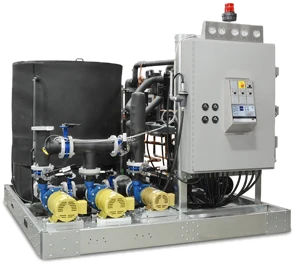
Two families cover this page. The TTI water-cooled central chillers are complete: two or three refrigeration zones, a 340- or 1,200-gallon tank and a 120 to 300 GPM process pump in one frame, 50 to 100 tons. The MW chilling modules, 46.4 to 100 tons on one to three circuits, are the refrigeration section alone, for a plant that has its own tank and distribution pumps.
WHAT TO SPECIFY
- Condenser water: 150 GPM of 85°F tower water on the TTI-50W up to 298 GPM on the TTI-100W, or about half those flows as 60°F city water.
- The tower is sized for the load plus the compressor heat.
- Tank: 340 gallons on the TTI-50W and TTI-60W, 1,200 gallons from the TTI-80W.
- Modules: the MW units have no tank or process pump - they connect to yours.
- Zones: two on most TTI units, three on the TTI-90W; one to three circuits on the MW modules (C, CC, CCC).
- Voltage: 230V, 460V or 575V three-phase throughout.
Capacity multiplier at a 30°F setpointA 100-ton rating at 50°F leaving water is 60 tons at brewery cellar glycol temperature. Pick the TTI or MW unit from the tons it delivers at your setpoint, not from the table rating.
Capacity at setpoint
What 100 Tons Becomes
1.
At 40°F
80 tons from a 100-ton rating (x 0.80).
A common process-water setpoint.
2.
At 30°F
60 tons (x 0.60).
Typical of brewery cellar glycol.
3.
At 20°F
40 tons (x 0.40).
Low-temperature holding duty.
INDOOR CENTRAL SYSTEMS, 40 TO 100 TONS
| Part Number | Series | Tons (50°F) | Zones | Tank / Pump | Voltage |
|---|---|---|---|---|---|
| TTI-50W | TTI Water-Cooled | 50 | 2 | 340 gal / 120 GPM | 230V / 460V / 575V |
| TTI-60W | TTI Water-Cooled | 60 | 2 | 340 gal / 144 GPM | 230V / 460V / 575V |
| TTI-80W | TTI Water-Cooled | 85.2 | 2 | 1,200 gal / 240 GPM | 230V / 460V / 575V |
| TTI-90W | TTI Water-Cooled | 90 | 3 | 1,200 gal / 270 GPM | 230V / 460V / 575V |
| TTI-100W | TTI Water-Cooled | 100 | 2 | 1,200 gal / 300 GPM | 230V / 460V / 575V |
| MW-50-C | MW Modules | 46.4 | 1 | Separate | 230V / 460V / 575V |
| MW-50-CC | MW Modules | 50 | 2 | Separate | 230V / 460V / 575V |
| MW-60-C | MW Modules | 60 | 1 | Separate | 230V / 460V / 575V |
| MW-60-CC | MW Modules | 60 | 2 | Separate | 230V / 460V / 575V |
| MW-70-CC | MW Modules | 70 | 2 | Separate | 230V / 460V / 575V |
| MW-80-CC | MW Modules | 80 | 2 | Separate | 230V / 460V / 575V |
| MW-90-CCC | MW Modules | 90 | 3 | Separate | 230V / 460V / 575V |
| MW-100-CC | MW Modules | 100 | 2 | Separate | 230V / 460V / 575V |
Ratings at 50°F leaving water. MW modules connect to a separate reservoir and pumping system.
TTI or MW Modules?
TTI water-cooled central chillers and MW modules for a plant loop run from a mechanical room on tower water.
Choose the TTI when the plant needs a whole central system: it arrives with its tank, pumps and controls, and the installation is the tower loop, the process header and power. Choose MW modules when a pump tank station is already in place and working, or when the plant wants to add capacity in steps. A module is lighter than a TTI of the same size - 2,200 lbs for the MW-50-CC against 4,990 lbs for the TTI-50W - because the tank and pumps are not on its frame.
The water side
A water-cooled plant is only as good as its tower water. Scale and fouling in the condenser raise head pressure and cut capacity long before anything trips, and the published tower and city flows assume a clean condenser. Budget for water treatment and a strainer ahead of the chiller.
Two zones on one tank
The TTI's zones share its tank and pump. At part load the plant runs on one zone and the tank carries the swings; with a zone down for service, the loop keeps running at reduced capacity. Where the whole loop must never stop, the next step is two units on a header - the approach on the plant-wide systems page.
The other line we supply covers this range as well - see its indoor central chillers, 20 to 180 tons on our sister chiller site.
Call and talk it through with an engineer: 1-805-484-2992