
1-805-484-2992
Quotes - Sizing - SalesOverview
A snow-melt or exposed hydronic loop lives outdoors year-round - the glycol mix, not just the chiller, is what keeps it from freezing solid.
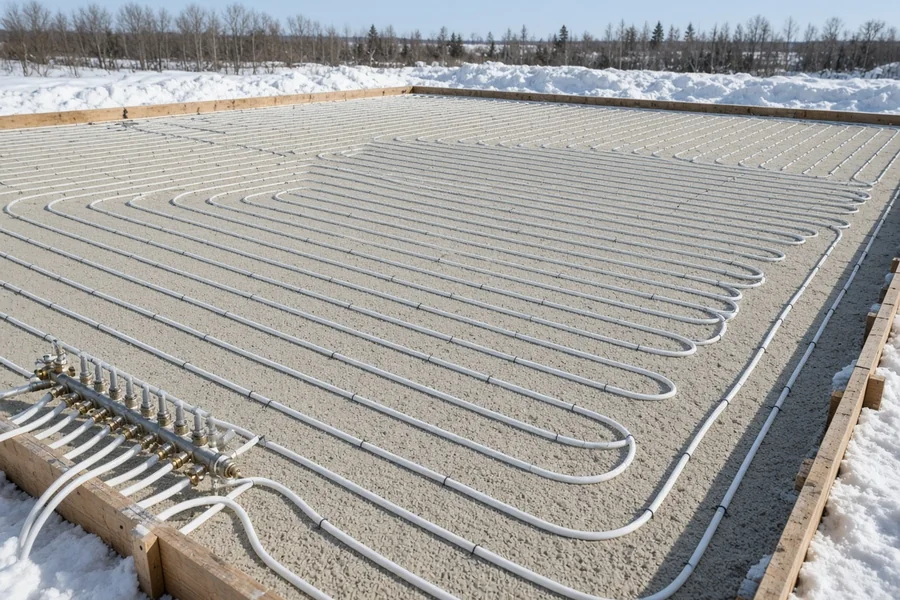
Any hydronic loop that runs outdoors or through an unheated space - a snow-melt slab, an exposed process line, a rooftop coil - needs freeze protection built into the fluid itself, because ambient temperature can drop well below what the loop's own operation would otherwise reach. A properly mixed propylene glycol solution depresses the freeze point of the loop, with the exact percentage set by the coldest temperature the site actually sees, not a rule-of-thumb mix.
Snow-melt circuits add a second variable on top of freeze protection: the loop has to deliver enough heat to melt snow at the rate it's falling, which is a real heat-output requirement, not just a "keep it from freezing" one. Undersizing a snow-melt chiller shows up as a slab that falls behind during a heavy snowfall rather than one that simply runs cold.
Because both duties are entirely outdoor and often run through the coldest part of the year, the chiller package itself needs a cold-weather operating rating in addition to the correct glycol mix - the two work together, and neither substitutes for the other.
- Glycol mix percentage is set by the site's actual design low temperature, not a default ratio
- Snow-melt duty is a heat-output requirement, not just freeze protection
- The chiller's own cold-weather operating rating matters as much as the glycol mix
Sizing Freeze Protection & Snow-Melt
Snow-melt load is set by slab area, target melt rate and local snowfall/design conditions - not the glycol chiller alone, since the melt-side heat comes from a boiler or heat source with the glycol loop protecting the circuit from freezing during idle periods. Freeze protection on other outdoor loops is a simpler calculation, driven by pipe run length and the coldest ambient the site sees.
The glycol percentage on a snow-melt or exposed hydronic loop is set for the coldest ambient temperature the site will realistically see, with margin - not the average winter low, since a single hard freeze below the design point is what causes loop damage.
Send Us
- Slab area or circuit pipe length
- Local coldest design ambient temperature
- Target melt rate or freeze-protection margin
- New construction or retrofit onto an existing loop
TYPICAL RANGES BY APPLICATION
| Application | Fluid Temp Role | Load Profile | Typical Glycol Mix |
|---|---|---|---|
| Snow-melt circuit | Loop protection, not primary heat | Seasonal, weather-driven | 35-50% propylene |
| General outdoor freeze protection | Idle-loop protection | Continuous through winter | 30-40% propylene |
Ranges are typical starting points, not a substitute for a design-temperature calculation - actual glycol percentage depends on your site's coldest design ambient and circuit exposure.
Call and talk it through with an engineer: 1-805-484-2992.