
1-805-484-2992
Quotes - Sizing - SalesOverview
A jacketed vessel or machine tool that can't shed process heat fast enough drifts off its setpoint - the glycol loop is what keeps it locked in.
A jacketed reactor, mixing vessel or process tank uses a fluid jacket to add or remove heat and hold the process inside a set temperature range - when the process is exothermic, that jacket runs on the cooling side, and the chiller feeding it has to match the reaction's real heat output, not a nominal vessel size. Undersizing here shows up as a process that drifts warmer as a batch progresses rather than one that fails outright.
Machine-tool cooling is a related but different duty: cutting, grinding and similar operations generate frictional heat at the tool-workpiece interface, and coolant temperature control affects both tool life and part tolerance on precision work. A stable glycol supply temperature holds tighter tolerances than a coolant loop that drifts with ambient shop temperature over a shift.
Because both applications span every kind of manufacturing plant rather than one named industry, sizing comes down to the actual heat rejection number for the specific vessel or machine - send us that figure, or the process details needed to estimate it, and we'll size accordingly.
- Jacketed vessel cooling has to match a reaction's real heat output, not nominal tank size
- Machine-tool coolant temperature affects both tool life and part tolerance
- Sizing runs off the equipment's actual heat rejection rate, independent of industry
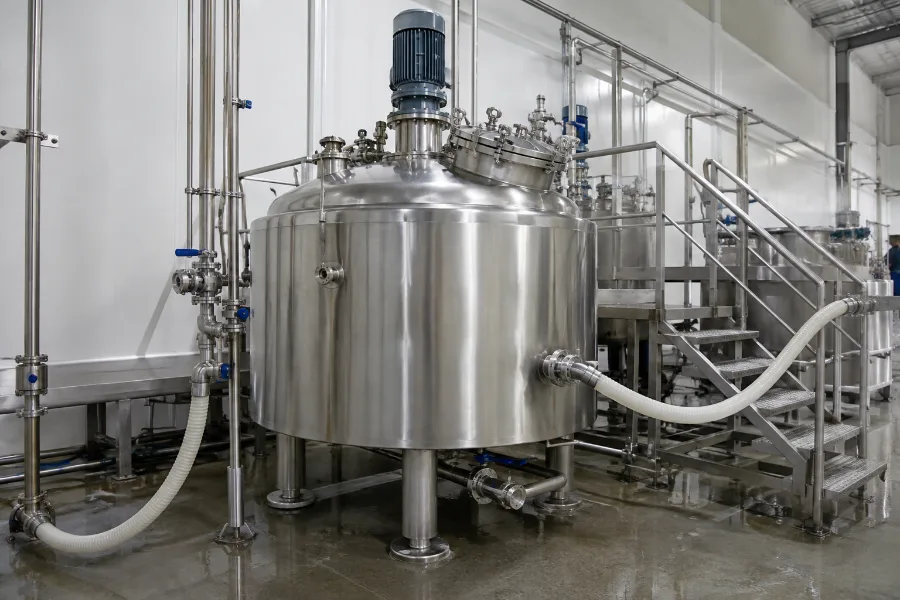
Sizing Machine & Tank Jacket Cooling
Jacketed vessel cooling is driven by the process reaction's or product's heat load and the vessel's target setpoint, not vessel volume alone - a highly exothermic reaction in a small vessel can outdemand a much larger tank running a mild process. Machine-tool coolant cooling is driven by spindle/cutting heat and runtime instead.
Where several machines or vessels run off one loop, the peak simultaneous demand - not the sum of every unit's nameplate rating - is what should size the chiller, since it's rare for every machine or vessel to be at its own peak load at the same moment.
Send Us
- Vessel volume and process heat load, or machine coolant spec
- Target jacket/coolant temperature
- Number of machines/vessels on one loop
- Indoor or outdoor installation
TYPICAL RANGES BY DUTY
| Duty | Leaving Fluid Temp | Load Profile | Typical Glycol Mix |
|---|---|---|---|
| Jacketed reactor/process vessel | 40-60°F | Batch or continuous, process-driven | 25-35% ethylene |
| Machine-tool coolant | 60-70°F | Continuous, runtime-driven | 20-30% ethylene |
Ranges are typical starting points, not a substitute for a process or spindle-load calculation - actual leaving fluid temperature and glycol percentage depend on your specific process and equipment.
Call and talk it through with an engineer: 1-805-484-2992.