
1-805-484-2992
Quotes - Sizing - SalesOverview
A mobile imaging suite has to bring its own cooling with it - the equipment's rated operating temperature doesn't change because the trailer moved sites.
MRI gradient coils, RF electronics and the cold-head compressor, and the tubes and detectors in CT and PET systems, all shed heat that has to leave within a tight temperature band to keep the scanner in calibration and protect it from damage. A trailer that moves between hospitals, clinics and outreach sites can't count on a building's central plant at each stop, so its cooling travels with it as a self-contained glycol chiller.
We supply new chillers only. Each one is bought by the trailer builder, the imaging provider or the fleet operator and stays with one trailer for the life of the scanner; we do not rent or loan chillers. That is why the selection is made for that trailer's scanner, its mounting space and its route, not pulled from a pool for a few weeks.
Sizing a mobile imaging chiller starts with the equipment manufacturer's rated heat rejection and required supply temperature - not a generic tonnage estimate - since imaging electronics are typically far less tolerant of temperature drift than most industrial process equipment. The chiller also has to be sized and configured for quick connect and disconnect between deployments, since a mobile unit that takes hours to commission at each site defeats the purpose.
Outdoor ambient conditions at each deployment site matter too - a trailer parked in a summer parking lot and one parked in a winter climate both need the chiller to hold the same tight equipment setpoint regardless of what's happening outside the trailer.
- Imaging electronics need a tight, manufacturer-rated supply temperature, not a generic tonnage estimate
- Quick connect/disconnect between deployment sites is a real design requirement, not a nicety
- Every chiller is a new unit purchased for one trailer - we do not offer rentals
- The chiller has to hold setpoint across whatever outdoor ambient range each site presents
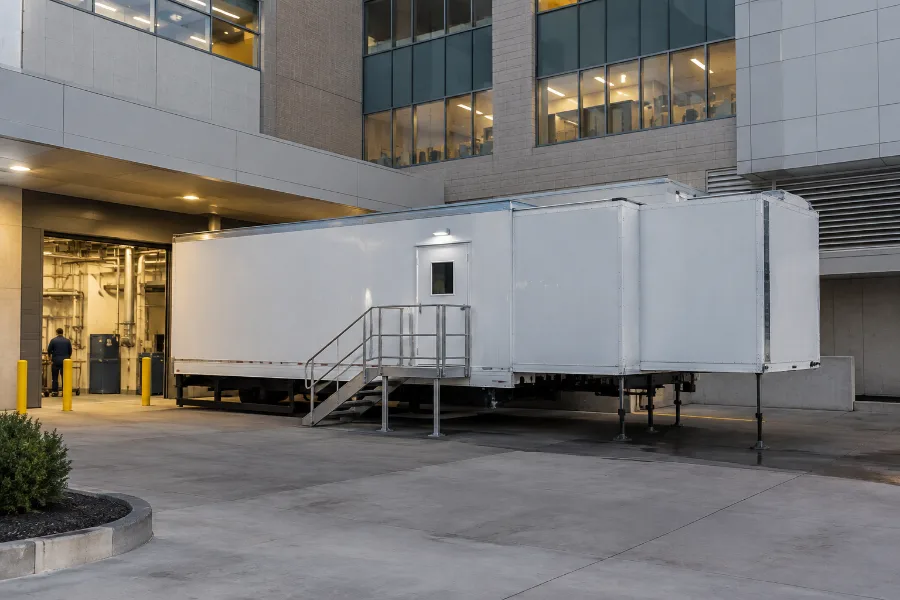
Sizing Mobile Imaging Suite Cooling
The imaging equipment manufacturer's own rated heat rejection and required fluid temperature are the two numbers that matter most - a mobile chiller undersized against that spec risks the imaging system faulting out mid-scan, not just running inefficiently.
Trailer footprint and mounting constraints often narrow the practical unit choice more than tonnage alone does, since the chiller has to fit and mount within the trailer's own structure without adding meaningful weight or height.
Send Us
- Imaging equipment make/model and rated heat rejection
- Required fluid temperature
- Trailer footprint and mounting constraints
- Climate range the trailer travels through
TYPICAL RANGES BY EQUIPMENT TYPE
| Equipment Type | Leaving Fluid Temp | Load Profile | Typical Glycol Mix |
|---|---|---|---|
| MRI system | 60-65°F | Continuous, tight tolerance | 25-35% propylene |
| CT / PET scanner | 60-70°F | Continuous, moderate tolerance | 20-30% propylene |
Ranges are typical starting points, not a substitute for the imaging equipment manufacturer's own cooling spec - actual leaving fluid temperature and glycol percentage depend on your specific system.
Call and talk it through with an engineer: 1-805-484-2992.