
1-805-484-2992
Quotes - Sizing - SalesOverview
An edge or modular data center is sized to a rack heat load in kilowatts, not a building footprint - the chiller needs to match that number exactly.
Modular and edge data center deployments - a containerized unit, a small equipment shelter at a remote site, an add-on module to an existing facility - are sized against a specific IT heat load in kilowatts, not a rule-of-thumb tonnage per square foot. A packaged outdoor glycol chiller matched to that exact kW figure, with headroom for planned growth, is the standard approach rather than an oversized central system built for future expansion that may never come.
Because these sites are often remote, unattended, or installed with a tight footprint, the chiller package itself has to handle outdoor ambient extremes reliably without regular hands-on service, and glycol gives the loop freeze protection that a water-only system installed outdoors simply can't offer.
Redundancy is also a real consideration at this scale - a single-module edge site with no cooling backup has a different risk profile than a larger facility with N+1 capacity already built in, and that's worth deciding explicitly rather than defaulting to whichever configuration is cheapest up front.
- Sizing runs off the actual IT heat load in kilowatts, with headroom for planned growth
- Remote or unattended sites need outdoor-rated hardware that tolerates ambient extremes reliably
- Redundancy (or its absence) is a deliberate decision at edge/modular scale, not a default
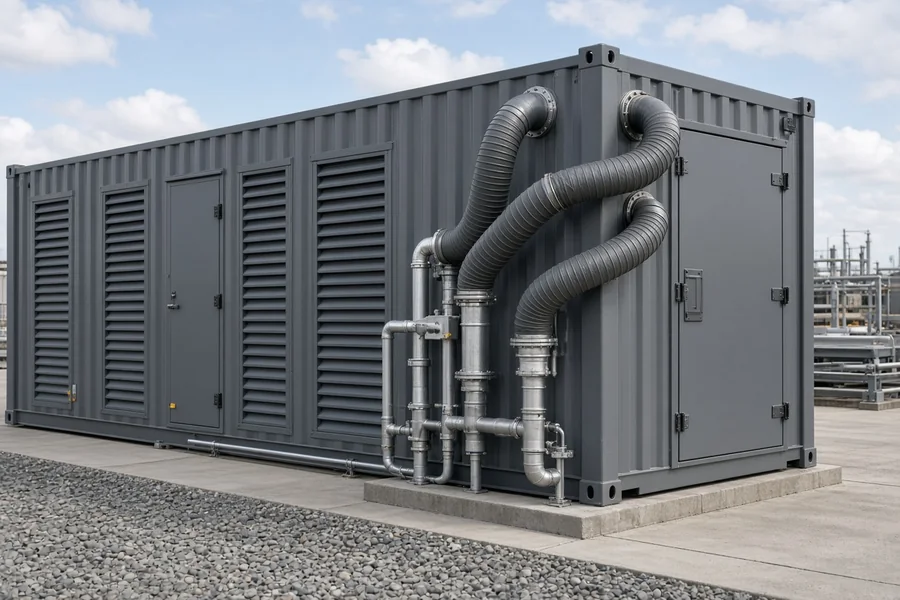
Sizing Modular & Edge Data Center Cooling
The chiller's capacity is matched directly to rack heat load in kilowatts, with margin for planned expansion of the module or edge site - not a rounded building estimate, since there usually is no building. Outdoor placement alongside the container or skid is the norm, so the package needs to be rated for the site's actual climate extremes.
Redundancy is usually specified at N+1 even on a single-module site, because a cooling failure at an edge location often has no on-site staff to respond quickly - the system needs to tolerate one unit going down without the rack load going unprotected.
Send Us
- Rack/IT load (kW) and planned growth margin
- Required supply/return fluid temperature
- Redundancy requirement (N, N+1)
- Site climate extremes (low ambient design temperature)
TYPICAL RANGES BY DEPLOYMENT
| Deployment | Leaving Fluid Temp | Load Profile | Typical Glycol Mix |
|---|---|---|---|
| Single-module edge site | 45-55°F | Continuous, kW-driven | 25-35% propylene |
| Multi-container modular buildout | 40-50°F | Continuous, redundant | 25-35% propylene |
Ranges are typical starting points, not a substitute for a load calculation - actual leaving fluid temperature and glycol percentage depend on your rack load, redundancy target and site climate.
Call and talk it through with an engineer: 1-805-484-2992.