
1-805-484-2992
Quotes - Sizing - Sales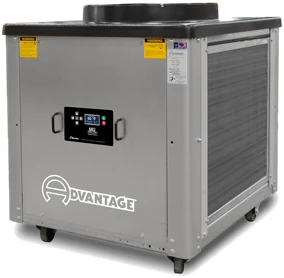
CG Series Air-Cooled
The press-side chiller: 2 to 30 tons, tank and pump on board, rolled to the machine and plugged into a three-phase drop.
| PRODUCT | TYPE | CAPACITY | MODELS |
|---|---|---|---|
| Portable Chiller | Air-Cooled | 2 to 30 Tons | 14 |
Specifications
Configuration & Size
Capacity:
2 to 29 tons
Models:
14 part numbers
Compressor:
Digital Scroll, Scroll, Tandem Scroll
Process Flow:
4.8 to 72 GPM
Refrigerant:
R-454B, R-513A
Construction
- Powder-coated steel frame and cabinet
- Brazed-plate evaporator, stainless plates
- Stainless centrifugal pump
- Insulated polyethylene reservoir
- Casters for portability
Specifications are Temptek's published figures (September 2026); confirm against the unit nameplate before ordering.
CG Series Air-Cooled Portable Chillers
The Standard Press-Side Chiller
Fourteen models cover 2 to 30 tons in one cabinet style: scroll compressor (digital or tandem scroll on the larger sizes), brazed-plate evaporator, an insulated polyethylene tank of 7.5, 25 or 65 gallons and a stainless centrifugal pump.
CG and CGD are the same family. The D marks the digital-scroll sizes at 5, 7.5 and 10 tons, which unload the compressor instead of bypassing hot gas and hold setpoint closer on a light or changing load.
At 15 and 20 tons there are three versions of the same chiller. AF has one condenser fan, AFF a bank of four smaller fans and a lower cabinet, AB a centrifugal blower rated against 1.35 inches of static pressure so the hot air can be ducted out of the building. Capacity is identical; the condenser air path is what differs.
Ratings are at 50°F leaving water, 95°F ambient and a 115°F condensing temperature. Minimum ambient is 60°F, and below a 48°F setpoint the loop needs glycol.
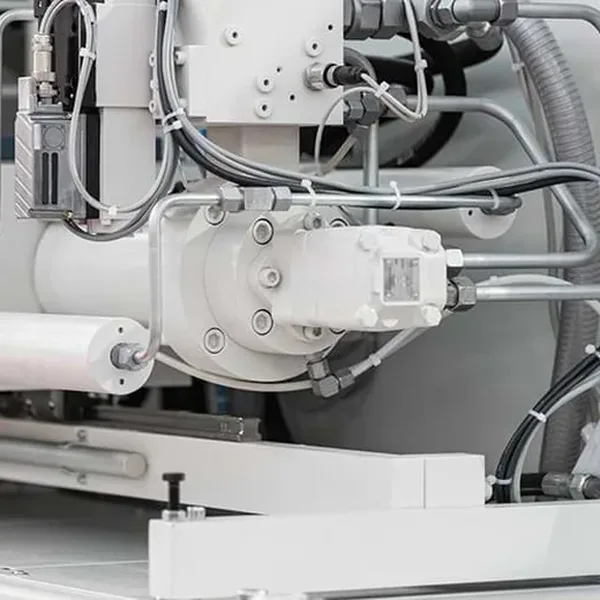
Tank, pump and air-cooled condenser in one cabinet, sized to sit beside a single machine.
Request a QuoteCG Series Air-Cooled Applications




What an Air-Cooled Portable Does to the Room
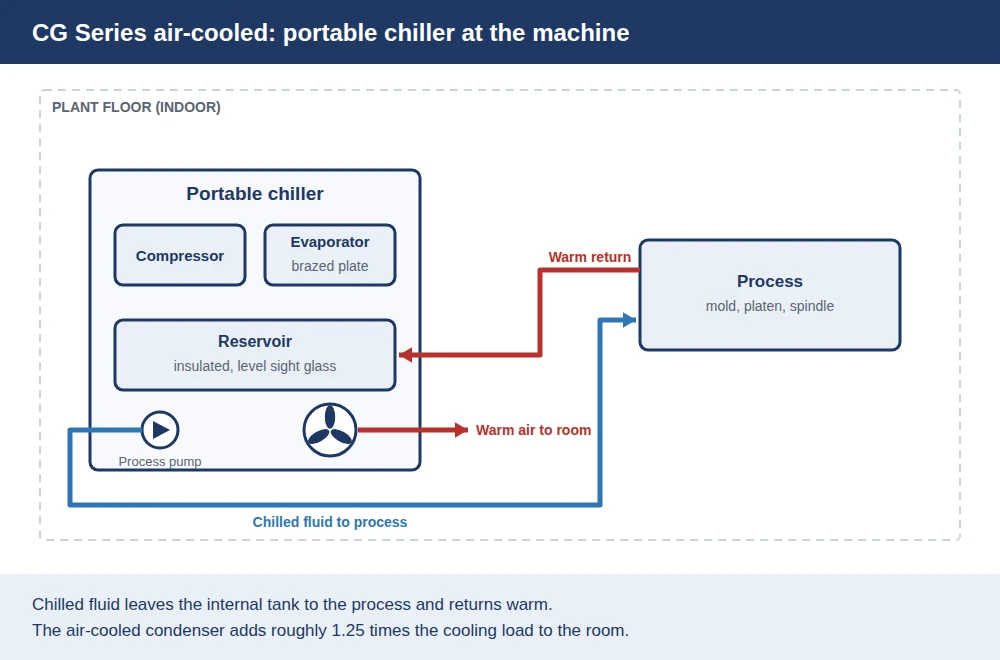
An air-cooled portable moves the process heat, plus the compressor work, into the room it stands in: roughly 1.25 times the cooling load. A CG-20AF at full load is putting about 25 tons of heat into the molding floor. Three of them in a row on a summer afternoon will lift the aisle temperature past the 95°F design ambient, and the units then lose capacity together.
That is what the AB blower version is for: its condenser air can be ducted outside. Where ducting is not practical, the water-cooled CG or a remote-condenser CG-ARC takes the heat out of the building instead. The pump is the other check. Each size carries one standard pump - 36 GPM at 55 PSI on the 15-ton units, 72 GPM on the 30 - and a mold with long, small passages may need the pressure more then the flow.
For the room-heat and pump questions in more detail, see indoor vs outdoor installation.
Call and talk it through with an engineer: 1-805-484-2992