1-805-484-2992

Quotes - Sizing - Sales
Replacement unit for the Filtrine PC One Pass Series

PC One Pass Series

Filtrine's one-pass chiller: no pump, no return line. The liquid passes through the storage tank once on its way to the product or drain.

PRODUCT TYPE CAPACITY MODELS
One-Pass Chiller One-Pass, No Pump 1,800 to 720,000 Btu/h 35

Specifications


Configuration & Size

Capacity:
1,800 to 720,000 Btu/h at 50°F
Models:
35 part numbers
Compressor:
1/4 to 2 x 40 hp
Pump:
Not fitted
Tank:
2 to 510 gallons

Construction

  • Hermetic, scroll or semi-hermetic
  • Welded stainless cooling tank
  • High-transfer immersion coil
  • No pump: line pressure
  • Storage design, no short-cycling

Ratings

  • Rated at 30, 50 and 68°F outlet
  • 90°F ambient, air-cooled
  • Thermostat 40 to 90°F
  • HFC refrigerant

Specifications sourced from Filtrine's published Process Chillers Specifications chart and per-model spec sheets (filtrine.com), October 2026. Filtrine is a trademark of its owner; referenced here for cross-reference only. Filtrine notes that dimensions and shipping weights vary with options. Confirm against the unit nameplate before ordering.

PC One Pass Chillers, 35 Sizes

Cooled Once, Then Used

For liquid that does not come back. Filtrine designs the PC for water that is cooled once and then added to a product as an ingredient, or fouled by what it cools: bakery dough water, rinses, spray washes, photo processing, reverse osmosis and sample lines.

No pump on board. The liquid enters under line pressure, passes the immersion coil in the storage tank and leaves; Filtrine says the coil gives full capacity at any flow with no pressure drop and no danger of freeze-up.

The same capacities as the PCP. From 1,800 to 720,000 Btu/h at 50°F outlet and 90°F ambient, named for the 68°F figure: the PC-75-7 makes 7,600 Btu/h at 68°F.

The tank smooths demand. Filtrine's storage design lets the unit meet a sudden draw from the stored volume and hold temperature without short-cycling the compressor.


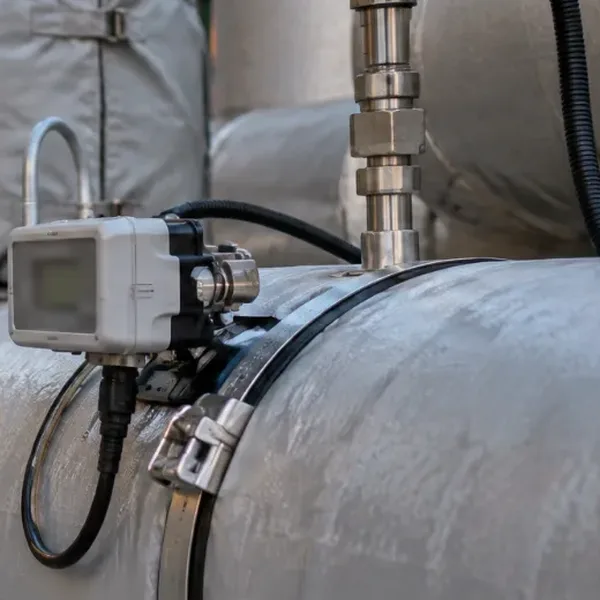
digital temperature sensors mounted on process piping

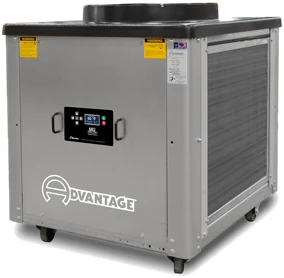
Compressor and a stainless storage tank with a high-transfer immersion coil, fed under line pressure.

Request a Quote

PC One Pass Series Applications

Bakery ingredient water
Poultry and spray washes
Sample and RO lines
Sample and RO lines
Food rinses
Food rinses

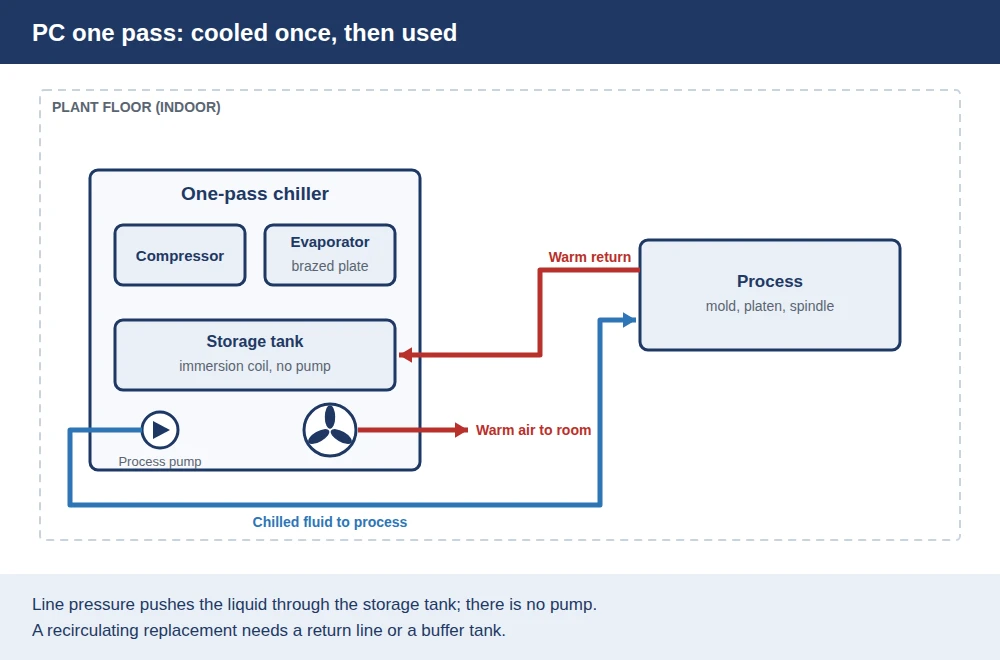
schematic of the PC One Pass series circuit, showing where the process fluid and the condenser heat go

One Pass Changes the Replacement

A one-pass chiller has no return line, so a recirculating replacement needs one, or a buffer tank that the new chiller keeps cold while the process draws from it. That is usually a small piping change, but it is a change, and it is worth settling before the old unit comes out. Draw rate matters more than average load: a bakery that pulls a batch of ingredient water at once needs stored volume as well as tons.

The glycol chiller sizing guide covers the load; the draw pattern is a conversation.

Every part-number page below names the Temptek unit we supply in it's place, sized to cover the 50°F figure; the page notes the return line or buffer tank a recirculating unit needs.
Call and talk it through with an engineer: 1-805-484-2992

Filtrine PC One-Pass: Piping, Ratings and Power

About 2.1 GPM if the line water has to come down 20°F to the 50°F outlet, or about 4.2 GPM for a 10°F pull-down. Both come from Filtrine's 50°F figure of 21,000 Btu/h divided by 500 x delta-T. Any draw faster than that runs down the stored volume, and the outlet warms once the tank is spent. A worked case: a line that draws 6 GPM for ten minutes at a 20°F pull-down asks for 60,000 Btu/h while it runs, nearly three times what the PC-200-27 makes, and the 2.1 GPM the compressor can follow leaves almost 40 gallons to come from storage. The mistake is sizing from the day's average water use, which hides a draw that runs at several times that rate for ten minutes. When a recirculating Temptek unit takes over, these numbers become the buffer tank's job: the tank stores the cold, and the chiller recovers it between draws.

Start with at least the stored volume the old PC had, then size up from the largest batch drawn at once. Filtrine's tanks span 2 to 510 gallons; the PC-100-10 holds 12 gallons and the PC-2500S-270 holds 140. A bakery pulling 100 gallons of dough water per batch from a PC-2500S-270 is leaning on its tank, not its compressor, and a buffer tank smaller than the batch hands the mixer warm water partway through. Then check recovery: the time between batches has to be long enough for the chiller to bring the tank back to set point. Send the batch size, the batch interval and the incoming water temperature.

It no longer comes from the water line. A PC passes liquid through its tank under line pressure, so every use point has always seen plant pressure. With an open buffer tank, the draw point gets only what a pump or a pressurized tank provides, and the first sign is spray nozzles that dribble. Tell us the pressure each use point needs, and the buffer arrangement is laid out to deliver it.

The condenser is remote: from the PC-5000-540 up, Filtrine offers only a remote air- or water-cooled condenser, so the old installation has refrigerant lines running to a condenser elsewhere in the building or on the roof. The selection then depends on what you want to keep. If that remote location is the only place the heat can go, we need its position, the line run and the height difference. If tower water is close by, a water-cooled arrangement may simplify the job. Whether any of the old refrigerant lines can be reused is decided on site, not assumed, and the quote states what was assumed.

Quote Request Form:

Questions?

1-805-484-2992

Quotes - Sizing - Sales