
1-805-484-2992
Quotes - Sizing - Sales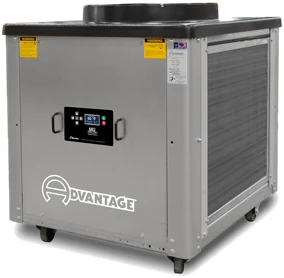
POC Open Loop Series
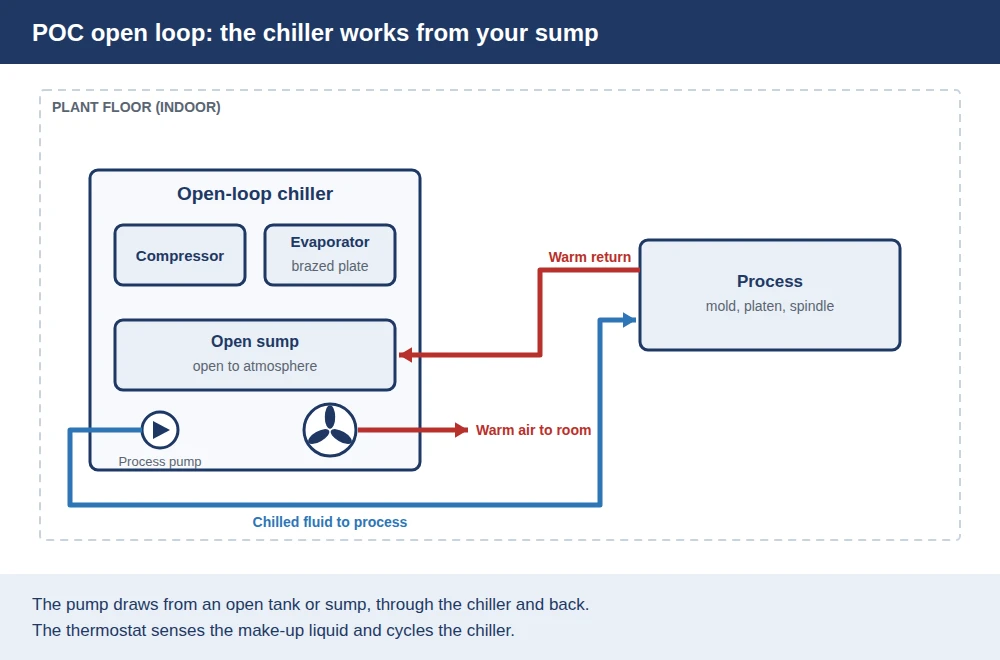
Filtrine's open-loop chiller: the pump draws from an open tank or sump, through the chiller and back, with the thermostat on the make-up liquid.
| PRODUCT | TYPE | CAPACITY | MODELS |
|---|---|---|---|
| Recirculating Chiller | Open-Loop Recirculating | 1,800 to 720,000 Btu/h | 35 |
Specifications
Configuration & Size
Capacity:
1,800 to 720,000 Btu/h at 50°F
Models:
35 part numbers
Compressor:
1/4 to 2 x 40 hp
Pump:
1/14 to 5 hp
Loop:
Open tank or sump
Construction
- Hermetic, scroll or semi-hermetic
- Stainless cooling tank
- Immersion coil evaporator
- Centrifugal pump
- Thermostat on the make-up liquid
Specifications sourced from Filtrine's published Process Chillers Specifications chart and per-model spec sheets (filtrine.com), October 2026. Filtrine is a trademark of its owner; referenced here for cross-reference only. Filtrine notes that dimensions and shipping weights vary with options. Confirm against the unit nameplate before ordering.
POC Open Loop Chillers, 35 Sizes
Built Around Your Sump
The same thirty-five sizes as the PCP. The POC shares Filtrine's chart row and spec sheet with the PCP of the same size, from 1,800 to 720,000 Btu/h at 50°F outlet and 90°F ambient.
The loop is open. Liquid is pumped from an open tank or sump, through the chiller and back to the sump, rather than circulating in a sealed loop.
The thermostat watches the sump. Filtrine's adjustable thermostat senses the make-up liquid temperature and cycles the chiller to hold the sump constant.
Pumps and compressors match the PCP. From a 1/14 hp pump and 1/4 hp compressor on the 25-2 to a 5 hp pump and twin 40 hp compressors on the 8000-860.

Compressor, stainless tank with an immersion coil, and a pump that draws from your open sump.
Request a QuotePOC Open Loop Series Applications




Open Loops Need a Look at the Sump
An open-loop chiller works with what is already there: a tank, a trough, a sump. The sump's volume, how far the pump lifts from it and what falls into it all decide how well the chiller holds temperature. When it is replaced, that sump either becomes the return to a new closed loop or the system is rebuilt around a new tank.
The glycol chiller sizing guide works the load from flow and temperature rise.
Every part-number page below names the Temptek unit we supply in its place, sized to cover the 50°F figure; the page notes that the Temptek unit runs its own closed loop.
Call and talk it through with an engineer: 1-805-484-2992