
1-805-484-2992
Quotes - Sizing - SalesHouston-Built Chillers by the Ton
Eight Cold Shot lines, 169 part numbers, from a 1/4-ton CSAC portable to a 100-ton water-cooled WCWC. Each one is listed with its published figures and the unit we supply in its place.
Cold Shot Chillers builds in Houston, Texas, and sells its range the way it publishes it: one table per size, from a quarter ton to a hundred, with every row a model number, a condenser type and a style. The style is the part to read first. A portable unit carries its own pump and tank; a stationary unit is the refrigeration circuit only, piped to a separate pump and reservoir; a reverse flow unit has a pump and no tank, drawing from an open trough; a continuous flow unit works the same open loop through an extra heat exchanger. Capacity is published at 50°F leaving fluid, against 95°F ambient for the air-cooled units and 85°F condenser water for the water-cooled ones. The figures on these pages are Cold Shot's own.
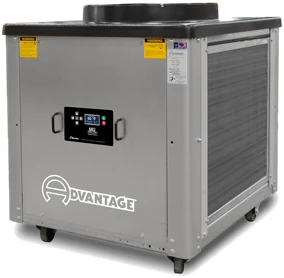
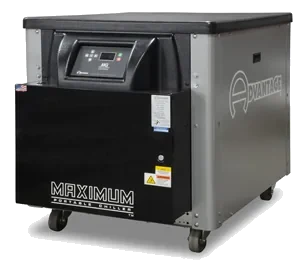
- ACWC portable air-cooled chillers run 1.5 to 90 tons with pump and tank on board.
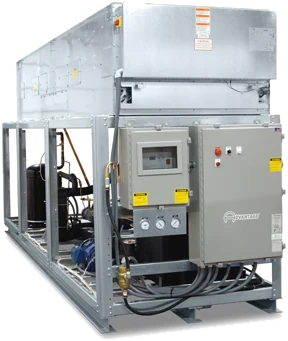
- ACWC stationary units, 1.5 to 90 tons, are refrigeration only for a separate pump and tank.
- ACWC reverse and continuous flow units, 1.5 to 90 tons, serve open-loop processes.
- WCWC portable water-cooled chillers run 1.5 to 100 tons on tower or plant water.
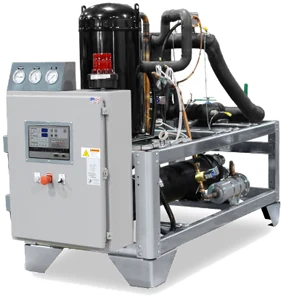
- WCWC stationary units run 1.5 to 80 tons without pump or tank.
- WCWC reverse flow units run 1.5 to 100 tons on an open loop.
- CSAC air-cooled chillers run from 1/4 ton to 100 tons, including 120 V fractional units.
- EZ Chillers are 2, 3 and 5-ton starter units for 44 to 70°F leaving fluid, indoors only.
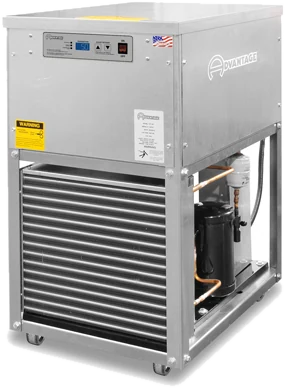
Reading a Cold Shot Part Number
The prefix is the condenser. ACWC is an air-cooled water chiller and WCWC a water-cooled one; CSAC is Cold Shot's air-cooled line that reaches down to a quarter ton, and EZWC the EZ Chiller. The number after the prefix is the capacity in thousands of Btu/h: an ACWC-120 is 120,000 Btu/h, 10 tons, and a WCWC-1200 is 100 tons.
The letter after the number is the frame. Cold Shot uses Q on the small ACWC units, E on most WCWC units and the middle ACWC sizes, GC on the larger ones, and B, C and D on the CSAC line. Its Chiller Specifications page and it's per-size pages do not always carry the same letter at the same size: the per-size pages list an ACWC-480-E two-stage 40-ton unit, for example, where the specifications page lists an ACWC-480-GC. Both are listed here, each with the figures its own page gives.
The suffix is the style. No suffix is a portable with pump and tank. ST is stationary, RF reverse flow, EXCH continuous flow with an extra heat exchanger, and DM and DP mark units the table lists with more than one pump rating or a dual-pump package.



Replacing a Cold Shot Chiller
We do not sell Cold Shot equipment. We supply new Temptek chillers, and every Cold Shot part-number page names the Temptek unit we would put in its place: the same condenser type, the smallest size that covers the published Cold Shot capacity, and a link to that unit's own page on this site. Both makers rate at 50°F leaving fluid, so the comparison is like for like. An ACWC or CSAC portable maps to a Temptek CG portable, a fractional-ton CSAC to a Temptek CF, a WCWC portable to a water-cooled CG, and the larger sizes to Temptek TTI central chillers. Stationary air-cooled units map to Temptek's outdoor packaged chillers, and stationary water-cooled units to its MW chilling modules, which like them carry no tank.
The style matters more than the tonnage in a Cold Shot replacement. A reverse flow or continuous flow unit is part of an open loop, fed by gravity from a trough or tank; our closed-loop portables carry their own tank, so the piping around the old unit has to be looked at before the swap. Cold Shot publishes no set point range in its model tables; if your process runs below 50°F, the unit you have makes less than its rating, and so will the replacement. Before quoting we ask for the nameplate model and serial, the style, the set point, the glycol type and mix, and the voltage.
Call and talk it through with an engineer: 1-805-484-2992
Specifications sourced from Cold Shot Chillers' published Chiller Specifications page, per-size chiller pages and EZ Chiller page (waterchillers.com), September 2026. Cold Shot Chillers, EZ Chiller and Guardian are trademarks of their owner; referenced here for cross-reference only. Confirm against the unit nameplate before ordering.
Before You Order
REPLACE • REFRIGERANT
Refrigerant Phase-Out
Older units in the field may still run R-22 or R-410A. What the refrigerant change means for service, retrofit and replacement.
+ Learn More
REPLACE • INSTALL
Swap-Out Checklist
Rigging, electrical, piping and start-up items to settle before the old chiller comes out of service.
+ Learn More
REPLACE • CONDITION
Signs You Need a New Chiller
Short cycling, rising amps, a tank that will not pull down: the symptoms that say the old unit is near the end.
+ Learn More