1-805-484-2992

Quotes - Sizing - Sales
Replacement unit for the Cold Shot ACWC Stationary Air-Cooled Series

ACWC Stationary Air-Cooled Series

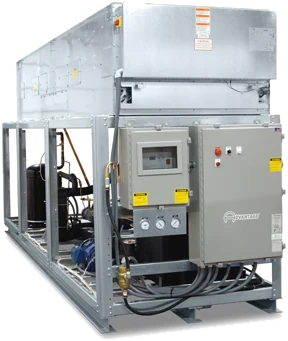
The refrigeration circuit on its own: Cold Shot's stationary air-cooled chillers, 1.5 to 90 tons, piped to a separate pump and reservoir.

PRODUCT TYPE CAPACITY MODELS
Central Chiller Air-Cooled Stationary 1.5 to 90 Tons 21

Specifications


Configuration & Size

Capacity:
1.5 to 90 tons at 50°F
Models:
21 part numbers
Pump:
Not on board
Condenser:
Air-cooled
Refrigerant:
R-410A

Construction

  • Scroll compressors, R-410A
  • Air-cooled microchannel condenser
  • Balanced-port expansion valves
  • Bronze Y-strainer, 20 mesh
  • Indoor or outdoor installation

Ratings

  • Rated at 50°F leaving fluid
  • 95°F ambient air
  • Refrigerant R-410A
  • Separate pump and tank required

Specifications sourced from Cold Shot Chillers' published Chiller Specifications page, per-size chiller pages and EZ Chiller page (waterchillers.com), September 2026. Cold Shot Chillers, EZ Chiller and Guardian are trademarks of their owner; referenced here for cross-reference only. Confirm against the unit nameplate before ordering.

ACWC Stationary Air-Cooled Chillers, 1.5 to 90 Tons

A Chiller Without a Pump or Tank

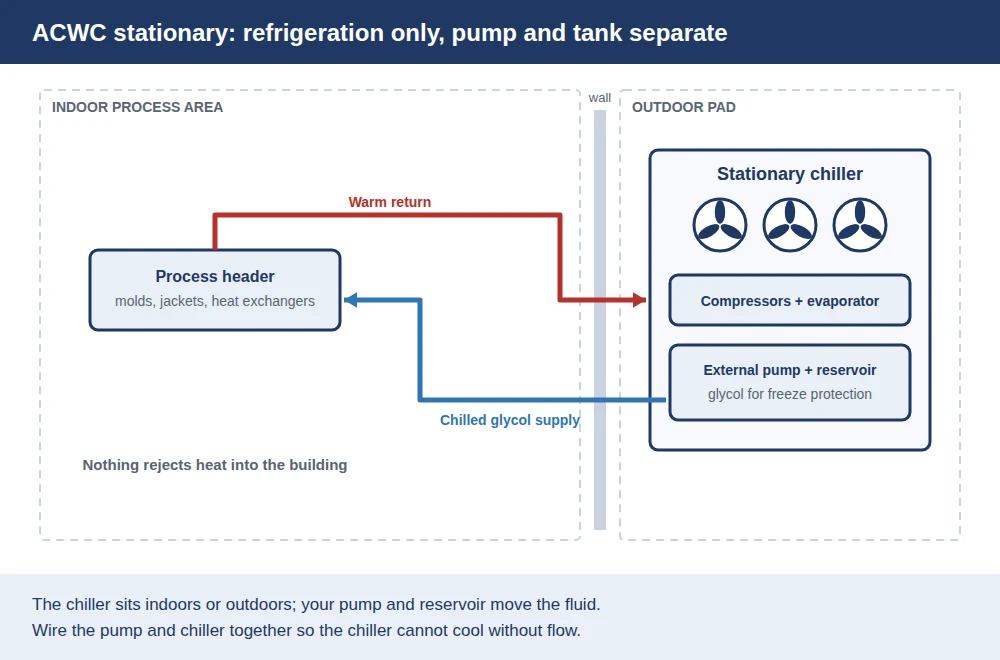
Twenty-one models, all with the ST suffix. Cold Shot defines a stationary chiller as one with no pump and no tank: a stand-alone refrigeration unit that must be piped to a pump and a separate reservoir to work. The line runs from the ACWC-18-Q-ST to the ACWC-1080-GC-ST.

Capacity is published at 50°F leaving fluid and 95°F ambient, the same rating as the portables of the same size: 18,000 to 1,080,000 Btu/h. Cold Shot describes the units as suitable for indoor or outdoor installation, on the roof or at ground level.

Controls come in two parts. The chiller and the pump have separate controls and separate electrical connections. Cold Shot recommends wiring them together so the chiller cannot cool unless the circulating pump is running.

Voltage narrows at the top. The Q and E frames are listed on 208-230 V or 460 V; several large GC stationary units, the ACWC-360-GC-ST and the 60 to 90-ton models, are listed on 208-230 V three-phase only on the specifications page.


food pieces moving along a perforated stainless steel conveyor drum

Refrigeration only: the chiller makes cold fluid, and your pump and tank move it.

Request a Quote

ACWC Stationary Air-Cooled Series Applications

Rooftop and pad installs
Existing pump-tank systems
Central chilled water
Winter glycol loops
Winter glycol loops

schematic of the ACWC Stationary Air-Cooled series circuit, showing where the process fluid and the condenser heat go

The Pump and Tank Are Yours

A stationary chiller makes sense where the plant already has the rest of the system: a reservoir sized for the process, pumps chosen for the pipe run, perhaps a standby pump. The chiller only has to take heat out of the fluid that is pumped through it. That also means its flow is whatever your pump delivers, and the evaporator needs the flow it was designed for.

Outdoors, the loop sees freezing weather even if the process runs warm, so the fluid needs glycol at a concentration that protects the coldest night on site. The glycol type and mix guide covers the mix and what it does to capacity.

Every part-number page below names the Temptek unit we supply in its place, sized to cover the published 50°F capacity. To 5 tons that is a Temptek CG portable, which brings its own pump and tank; from 7.5 tons it is a Temptek outdoor packaged chiller, single-circuit to 50 tons and dual-zone above.
Call and talk it through with an engineer: 1-805-484-2992

Before You Replace an ACWC Stationary Chiller

The compressor pulls down the water trapped in the evaporator with no flow to carry the cold away, and at a low set point that is how evaporators freeze and split. That risk is the reason behind Cold Shot's advice to wire the two together. Without the interlock, the usual sequence is a pump tripping on overload, or being shut for maintenence, while the chiller keeps calling for cooling. A flow switch in the evaporator line, proven before the compressor may start, covers the case the interlock misses: the pump running against a closed valve. On the Temptek replacement above 5 tons, tell us how the existing pump is started, so the controls are tied together the same way.

At the rating point, yes, by about 8 percent: the dual-zone TTOACS-80D-MZC-2P is rated 75.8 tons at 50°F against the 70 tons of the ACWC-840-E-ST. The 90-ton ACWC-1080-GC-ST does better, with about 22 percent from the TTOACS-120D-MZC-2P at 110.1 tons. Cold Shot and Temptek share the 50°F leaving-fluid basis, which makes those percentages real margin, not a correction. The thinner one deserves a second look: if the 70-ton loop runs glycol, or a set point below 50°F, the 8 percent can be used up before anyone notices. Tell us the fluid and the set point, and we confirm the pick at that condition.

No, but the supply you have decides the electrical work, so give us the voltage at the disconnect before anything is selected. The ACWC-360-GC-ST, like the GC models from 60 to 90 tons, is shown with only a 208-230 V three-phase listing, so a plant that runs 460 V everywhere else may have a dedicated 208-230 V feed or a transformer just for that chiller. At 460 V the same load draws roughly half the current, so the breaker and feeder are re-selected from the new unit's data rather than kept as they stand. The reverse slip happens too: a 460 V replacement ordered for a 230 V feed. We select for the voltage you name and send the electrical data with the quote.

It freezes on the first hard night the process sits idle, usualy in the evaporator or an exposed pipe run, and the damage shows up as a leak at startup. A stationary unit on a roof or pad keeps its loop in winter air even when the process runs at 50°F all day. The fix is glycol mixed for the coldest night on site, but the mix lowers capacity and raises pumping power, so it belongs in the selection rather than being added afterward. Tell us the glycol type and percentage with the request, and the Temptek outdoor packaged chiller is rated on that fluid.

Usually not both: the Temptek CG portable brings its own pump and tank, so the existing pump either becomes a booster for a long run or comes out of the loop. Two unmatched pumps in series tend to fight: the weaker one turns into a restriction, or the downstream one is starved and cavitates. The reservoir is easier to keep, as extra thermal volume on the return side. Send the distance to the load, the pipe size and what the external pump delivers now, and we confirm with you which pieces stay.

Quote Request Form:

Questions?

1-805-484-2992

Quotes - Sizing - Sales