
1-805-484-2992
Quotes - Sizing - Sales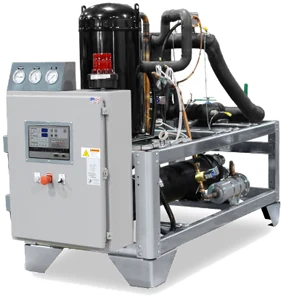
WCWC Stationary Water-Cooled Series
Water-cooled refrigeration for a plant that already has its pumps and tank: Cold Shot's stationary WCWC units, 1.5 to 80 tons.
| PRODUCT | TYPE | CAPACITY | MODELS |
|---|---|---|---|
| Central Chiller | Water-Cooled Stationary | 1.5 to 80 Tons | 15 |
Specifications
Configuration & Size
Capacity:
1.5 to 80 tons at 50°F
Models:
15 part numbers
Pump:
Not on board
Condenser:
Water-cooled
Refrigerant:
R-410A
Construction
- Scroll compressors, R-410A
- Water-cooled condenser
- Liquid receiver, head pressure control
- Bronze Y-strainer, 20 mesh
- Separate pump and reservoir
Specifications sourced from Cold Shot Chillers' published Chiller Specifications page, per-size chiller pages and EZ Chiller page (waterchillers.com), September 2026. Cold Shot Chillers, EZ Chiller and Guardian are trademarks of their owner; referenced here for cross-reference only. Confirm against the unit nameplate before ordering.
WCWC Stationary Water-Cooled Chillers, 1.5 to 80 Tons
Refrigeration Only, on Tower Water
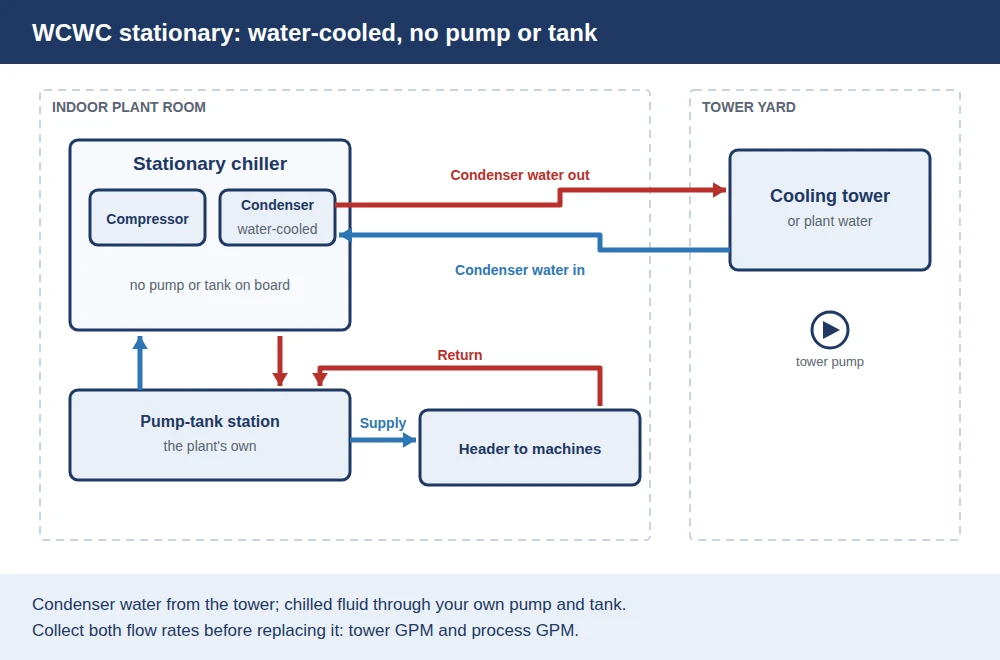
Fifteen models, all with the ST suffix. Like the air-cooled stationary units, these have no pump and no tank; the chiller is piped to a separate pump and reservoir, with its own controls and power connection.
Capacity is published at 50°F leaving fluid on 85°F condenser water from 18,000 Btu/h on the WCWC-18-E-ST. Most of the 25-ton and larger units are listed on Cold Shot's per-size pages, where they carry the air-cooled footnote; the 50°F leaving-fluid figure is shown for each, up to 960,000 Btu/h on the WCWC-960-GC-ST.
Refrigeration components are listed. Cold Shot lists scroll compressors, sight glass and moisture indicators, balanced-port expansion valves, a filter drier, pressure-actuated head pressure control and a liquid receiver on its water-cooled units.
Stationary water-cooled units go inside. Cold Shot describes its water-cooled chillers as typically installed indoors, close to the tower loop and the plant's pump-tank system.

A water-cooled refrigeration circuit that plugs into the pumps and reservoir the plant already runs.
Request a QuoteWCWC Stationary Water-Cooled Series Applications




Matching the Plant Around It
A stationary water-cooled chiller is a component in a plant: the tower, the condenser water pump, the process reservoir and the process pumps are all outside it. Replacing one is easiest when the new unit fits the same connections and the same flows, so the first thing to collect is the existing process and condenser water flow rates, the connection sizes and the voltage.
It is also the moment to check the condenser water. Cold Shot points out that untreated tower water leaves mineral deposits that cut heat transfer; a scaled condenser on the old unit may be why it no longer holds the set point. The tonnage and capacity guide explains how to count the load it actually has to carry.
Every part-number page below names the Temptek unit we supply in its place, sized to cover the published 50°F capacity: a Temptek CG water-cooled portable to 3 tons, and from 5 tons a Temptek MW water-cooled chilling module, which like the stationary units carries no tank and works with a pump-tank station.
Call and talk it through with an engineer: 1-805-484-2992