
1-805-484-2992
Quotes - Sizing - Sales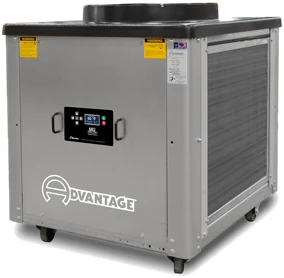
ACWC Reverse and Continuous Flow Series
Air-cooled chillers for open-loop processes: a pump and no tank, fed by gravity from your trough or reservoir, 1.5 to 90 tons.
| PRODUCT | TYPE | CAPACITY | MODELS |
|---|---|---|---|
| Portable Chiller | Open-Loop Air-Cooled | 1.5 to 90 Tons | 35 |
Specifications
Configuration & Size
Capacity:
1.5 to 90 tons at 50°F
Models:
35 part numbers
Styles:
Reverse and continuous flow
Process Pump:
1 to 7-1/2 hp
Refrigerant:
R-410A
Construction
- Scroll compressors, R-410A
- Air-cooled condenser
- Stainless centrifugal pump
- No tank: fed from a trough
- EXCH: extra heat exchanger
Specifications sourced from Cold Shot Chillers' published Chiller Specifications page, per-size chiller pages and EZ Chiller page (waterchillers.com), September 2026. Cold Shot Chillers, EZ Chiller and Guardian are trademarks of their owner; referenced here for cross-reference only. Confirm against the unit nameplate before ordering.
ACWC Reverse and Continuous Flow Chillers, 1.5 to 90 Tons
Built for an Open Loop
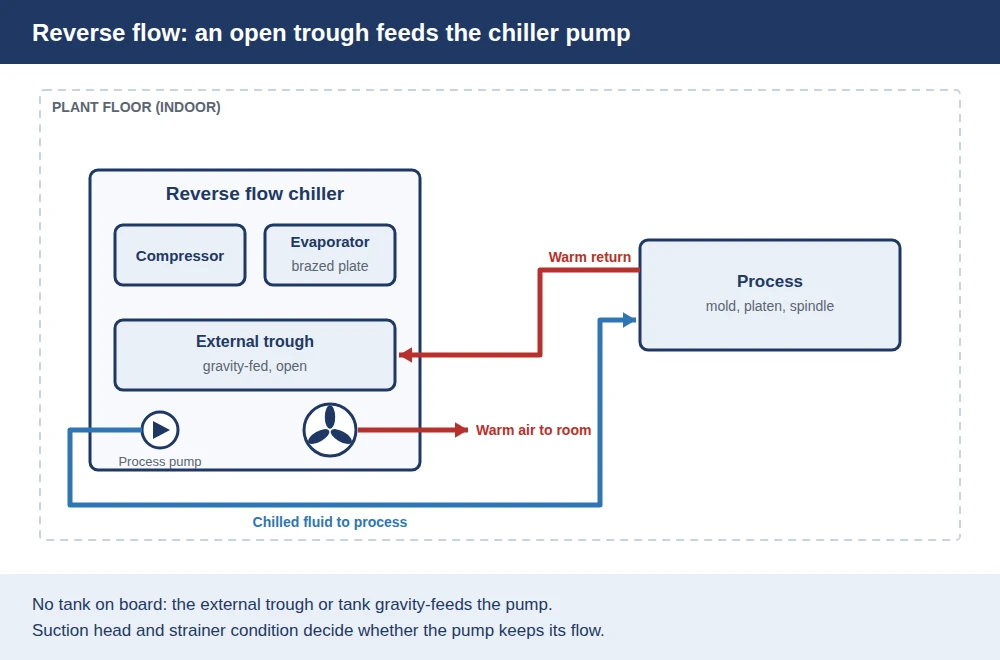
Thirty-five models in two styles. RF units are reverse flow: no holding tank, with the pump drawing from an external tank or trough that feeds it by gravity, sending fluid through the chiller and filter and back. EXCH units are continuous flow, the same open loop through an extra heat exchanger.
Capacity is published at 50°F leaving fluid and 95°F ambient, the same rating as the portables of the same size, from 18,000 Btu/h on the ACWC-18-Q-RF and -EXCH to 1,080,000 Btu/h on the ACWC-1080-GC-EXCH.
Pumps are listed per model. The reverse flow units mostly carry the pump of the matching portable. The continuous flow units often list a different one: the ACWC-480-GC-EXCH is listed at 5 hp for 135 GPM, against 7-1/2 hp for 160 GPM on the ACWC-480-GC-RF.
Two pages, two frame letters. The 25 to 40-ton and 70-ton reverse flow units appear as E-frame models on Cold Shot's per-size pages and some as GC models on its specifications page; both are listed here as published.
A pump and a chiller between your trough and your process, with the tank left where it already is.
Request a QuoteACWC Reverse and Continuous Flow Series Applications




Where the Water Comes Back by Gravity
A closed-loop portable pushes fluid out and gets it back under its own pump pressure. Plenty of processes do not work that way: a rinse tank, a plating bath, a flume or a sump collects the water at atmospheric pressure, and it runs back by gravity. That is the job of the reverse flow and continuous flow units: the external tank is the reservoir, and the chiller's pump pulls from it.
On an open loop, the tank's elevation relative to the pump inlet, the strainer and the return line all matter as much as the tonnage. A pump that loses its suction head cavitates, and an open tank picks up contamination the chiller's strainer has to catch. The glycol chiller sizing guide works the load from flow and temperature rise.
Every part-number page below names the Temptek unit we supply in its place, sized to cover the published 50°F capacity: a CG air-cooled portable to 25 tons and a TTI air-cooled central chiller from 30 tons. Both are closed-loop units with their own tank, so tell us how the return reaches the chiller and we set up the piping.
Call and talk it through with an engineer: 1-805-484-2992