1-805-484-2992

Quotes - Sizing - Sales
Replacement unit for the ICS Cool Energy i-Chiller Process Series

i-Chiller Process Series

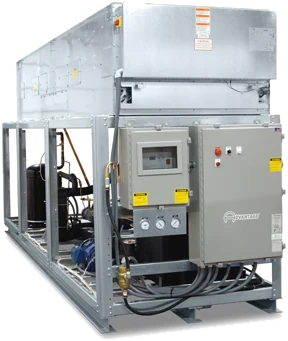
ICS's packaged process chiller: the i-Chiller Process, 5.66 to 154.66 kW nominal, with a 60 to 678-liter tank on board.

PRODUCT TYPE CAPACITY MODELS
Process Chiller Packaged, Air-Cooled 5.7 to 154.7 kW 18

Specifications


Configuration & Size

Capacity:
5.66 to 154.66 kW nominal
Models:
18 part numbers
Tank:
60 to 678 liters
Sound Power:
80.4 to 90.6 dB(A)
Supply:
400 V 3-phase

Construction

  • Packaged air-cooled
  • 60 to 678-liter storage tank
  • 3/4 to 3 in connections
  • 400 V three-phase
  • SEPR HT 5.02 to 5.59

Ratings

  • Nominal kW
  • EER 2.36 to 2.83
  • SEPR MT 2.74 to 3.99
  • Rating point not stated

Specifications sourced from ICS Cool Energy's published i-Chiller product pages and datasheets (icscoolenergy.com), October 2026. ICS Cool Energy and i-Chiller are trademarks of their owner; referenced here for cross-reference only. Capacities are ICS's nominal figures in kW, converted at 3.517 kW per ton. Confirm against the unit nameplate before ordering.

i-Chiller Process, 5.7 to 154.7 kW

Eighteen Sizes With a Tank

Eighteen models. From the IC220 at 5.66 kW to the IC780 at 154.66 kW nominal, in frames from 560 mm wide to 1,250 mm.

Efficiency is published. EER from 2.36 to 2.83, SEPR HT from 5.02 to 5.59 and SEPR MT from 2.74 to 3.99.

Tanks grow with the frame. 60 liters on the IC220 up to 678 liters on the IC770 and IC780, with 3/4 to 3-inch connections.

Three-phase. All on 400 V three-phase, 199 to 2,114 kg working weight.


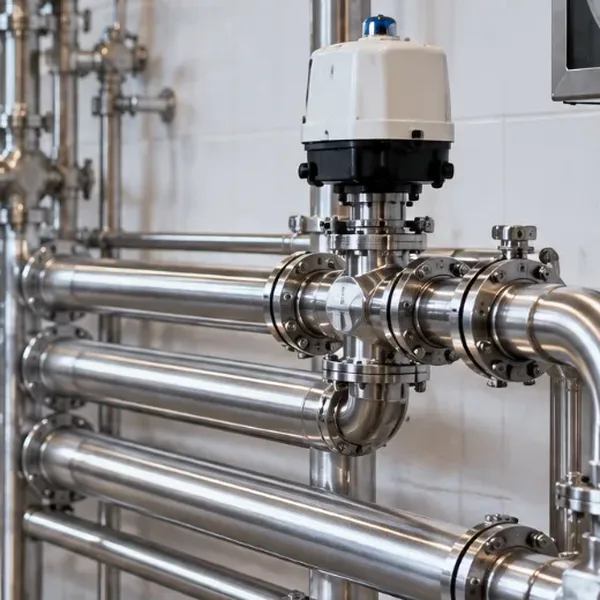
parallel runs of sanitary stainless piping with a diversion valve

Compressors, condenser, evaporator and a storage tank in one packaged air-cooled unit.

Request a Quote

i-Chiller Process Series Applications

Plastics molding
Plastics molding
Machine tools
Machine tools
Process cooling
Process cooling
Outdoor pads
Outdoor pads

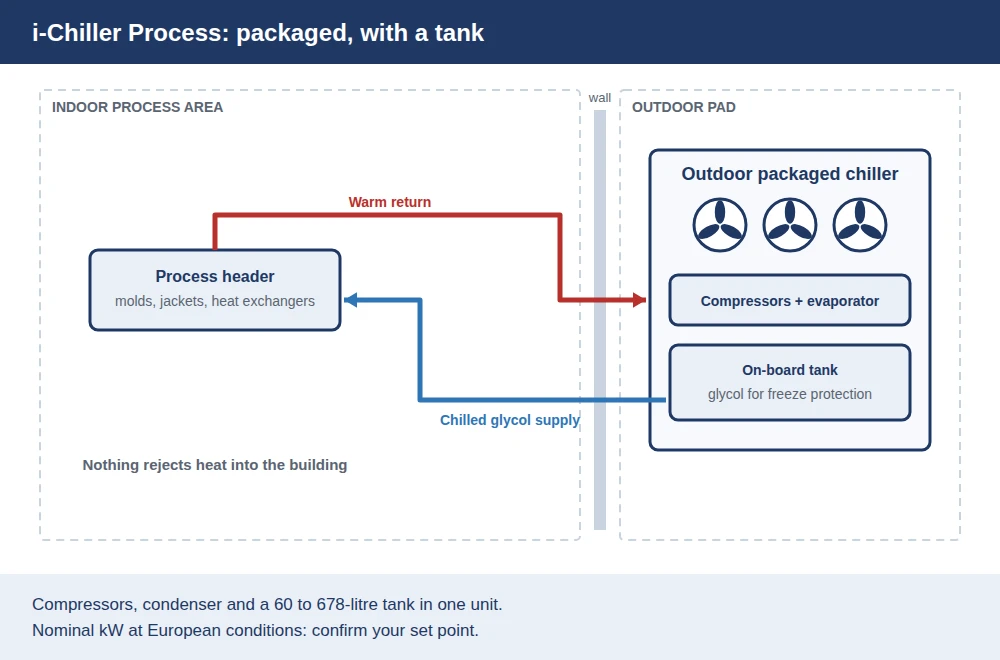
schematic of the i-Chiller Process series circuit, showing where the process fluid and the condenser heat go

Nominal Means European Conditions

The i-Chiller Process table gives a nominal kW without the rating point; ICS's own Compact n sheet uses 12/7°C and 35°C. The pick is sized on Temptek's 0.80 multiplier so it covers that, and is confirmed at your set point. The leaving fluid temperature guide explains why set point matters.

Every part-number page below names the Temptek unit we supply in its place, sized from ICS's nominal kW on Temptek's 0.80 multiplier at 40°F, which covers a 12/7°C rating, and built for North American supply rather than 400 V / 50 Hz.
Call and talk it through with an engineer: 1-805-484-2992

i-Chiller Process: Sizing and Swap-Out Questions

Very tight: the IC780's 154.66 kW is about 43.98 tons, which calls for 54.97 tons after the 0.80 multiplier, against the TTOACS-60S-CG-1P's 55.1 tons at 50°F. That leaves about 0.13 tons, well under one percent. On paper it covers ICS's nominal figure, but there is no room for a set point colder than 7°C, a summer ambient above the 35°C the sizing assumes or a load that has grown since the IC780 went in. Send the set point, the highest summer ambient at the pad and a measured load, and expect the selection to step up if any of the three is worse than nominal. Smaller sizes have more in hand: the IC412's 9.82 tons calls for 12.28 against the TTOACS-15S-CG-1P's 14.4.

Yes, by the IC412 the pick is an outdoor packaged unit, the TTOACS-15S-CG-1P rated 14.4 tons, and the IC780 goes to the TTOACS-60S-CG-1P. That changes the installation, not just the chiller. An indoor IC412 rejects its condenser heat into the building; its replacement needs a pad, a pipe run through the wall and glycol in any length of loop that sees winter. At the small end the picks stay portable, the CG-3A at 2.9 tons for the IC220 and the CGD-5A at 4.9 tons for the IC305, so those can stay in the room.

Often, yes, when the process has short, sharp loads, because the i-Chiller Process carries a lot of fluid on board: 60 liters on the IC220 rising to 678 liters on the two largest frames, roughly 16 to 179 gallons. The IC520 and IC535 hold 350 liters and the IC660 500. A molding cell or machine tool that dumps heat in bursts has been leaning on that volume to hold leaving temperature between compressor starts. Compare it with the tank on the unit quoted, and if the gap is large, add a buffer tank in the return so the compressor does not short-cycle.

On the same basis, sound power against sound power, because the 80.4 to 90.6 dB(A) ICS lists is the noise the unit emits, not what a listener hears some distance away. A sound pressure figure taken at a stated distance reads lower than the sound power of the same machine. The common mistake is setting a replacement's pressure figure beside the ICS power figure and concluding that the new unit is quieter. If the site has a limit at a property line or an office wall, give us that limit and the distance, and the comparison is made there.

They show how much efficency the same machines lose when they make colder fluid: the medium-temperature rating, SEPR MT, runs 2.74 to 3.99 against 5.02 to 5.59 for SEPR HT. The high-temperature figure is calculated for a warm chilled-water outlet, the medium one for a much colder outlet. The gap is the same physics that cuts capacity at a lower set point. If your unit runs colder than the 7°C the sizing assumes, expect both its capacity and its efficiency to sit well under the nominal figures, and give us the set point.

Quote Request Form:

Questions?

1-805-484-2992

Quotes - Sizing - Sales