
1-805-484-2992
Quotes - Sizing - Sales
Iceman LT Series
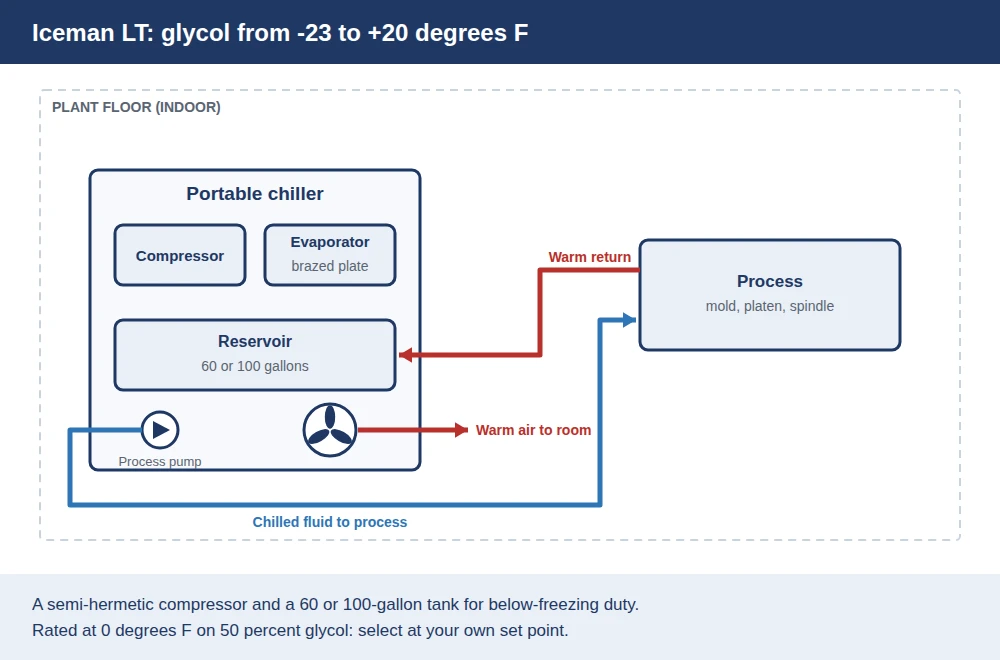
Mokon's low-temperature portable: semi-hermetic compressors for -23 to +20°F leaving fluid, rated at 0°F on 50% glycol.
| PRODUCT | TYPE | CAPACITY | MODELS |
|---|---|---|---|
| Portable Chiller | Low-Temperature Portable | 2 to 19 Tons at 0°F | 14 |
Specifications
Configuration & Size
Capacity:
28,025 to 226,100 Btu/h at 0°F
Models:
14 part numbers
Leaving Fluid:
-23 to +20°F
Process Pump:
2 to 5 hp
Circuits:
Single to 10 tons, dual above
Construction
- Semi-hermetic discus compressor
- Cylinder unloading (single circuit)
- Stainless brazed plate evaporator
- CPR valve
- 60 or 100-gallon tank
Specifications sourced from Mokon's published chiller product pages and series datasheets (mokon.com), October 2026. Mokon, Iceman, Full Range, Pura-Therm and Xtreme-Therm are trademarks of their owner; referenced here for cross-reference only. Mokon notes its technical data is subject to change without notice. Confirm against the unit nameplate before ordering.
Iceman LT Series, Rated at 0°F
Built for Below Freezing
Fourteen part numbers. Single-circuit ALT and WLT models from 2 to 10 tons, and dual-circuit ADLT and WDLT models at 15 and 20, air-cooled and water-cooled.
Capacity is published at 0°F, on 50% water and ethylene glycol: 28,025 Btu/h on the ALT-2 to 226,100 Btu/h on the WDLT-20, at 90°F ambient or 85°F condensing water.
The compressor is a semi-hermetic discus. Single-circuit units add cylinder unloading and hot gas bypass for capacity control, and every unit carries a CPR valve.
Tanks are larger for the size. Sixty gallons on the single-circuit units and 100 on the dual-circuit ones, with 2 to 5 hp pumps.

Semi-hermetic compressor, CPR valve, a 60 or 100-gallon tank and a stainless pump for glycol below 0°F.
Request a QuoteIceman LT Series Applications




Why These Pages Name No Unit
Every other Mokon page here names a Temptek unit matched at 50°F. The Iceman LT is rated at 0°F on 50% glycol, and Temptek publishes no rating at that point, so a tonnage comparison would be a guess. Its pages list Mokon's figures and send you to an application specialist instead. The Temptek line we supply stops at about 20°F leaving fluid, the very top of the LT's range.
A low-temperature selection starts from the set point, the glycol mix and the load at that set point. The glycol type and mix guide covers the mix, and the leaving fluid temperature guide why capacity falls so far below freezing.
Call and talk it through with an engineer: 1-805-484-2992