
1-805-484-2992
Quotes - Sizing - SalesProcess Chillers for the Plant Floor
Nine Thermal Care series, 105 part numbers, from a 1-ton EQ portable to a 256-ton TSE central chiller. Each one is listed with its published figures and the unit we supply in its place.
Thermal Care builds its Accuchiller line in Niles, Illinois, and the range reads like a plastics plant's equipment list: small EQ and NQ portables that sit beside a molding machine, TSE and TC central chillers that feed a whole header from a mechanical room, and KSE packaged units that put the entire chiller on a pad outside. Almost everything is rated the same way, at 50°F leaving coolant, with a set point range that reaches 20°F on the scroll-compressor lines and 40°F on the centrifugal ones. The figures on these pages are Thermal Care's own, taken from its unit pages and series specification tables.
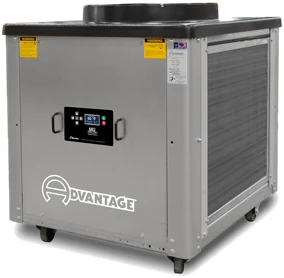
- EQ portables run 1 to 3 tons, air-cooled, water-cooled or with a remote condenser, set point 20 to 65°F.
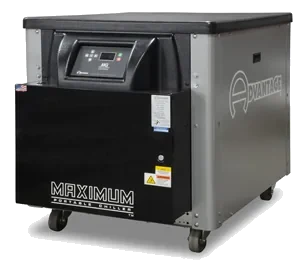
- NQ portables run 4 to 43 tons in the same three condenser styles, on one or two scroll compressors.
- TSE central chillers run 10 to 256 tons on scroll compressors, water-cooled or with remote condensers, single or dual circuit.
- TC central chillers run 60 to 240 tons per unit on oil-free Turbocor centrifugal compressors.
- TCF chillers pair a Turbocor compressor with a hybrid film evaporator, including a 13°F ice-rink model.
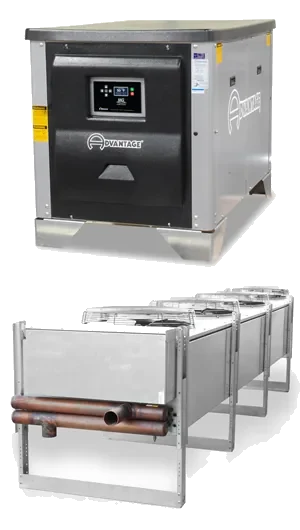
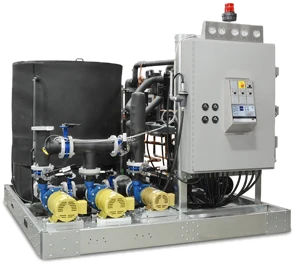
- KSE outdoor packaged chillers run 40 to 120 tons per unit, with an integral pump and tank package as an option.
- TSE and KSE units combine into plants of up to 12 refrigeration circuits.
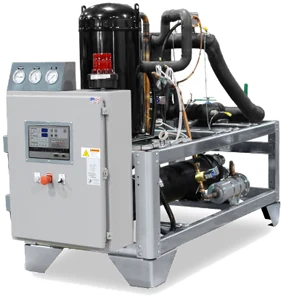
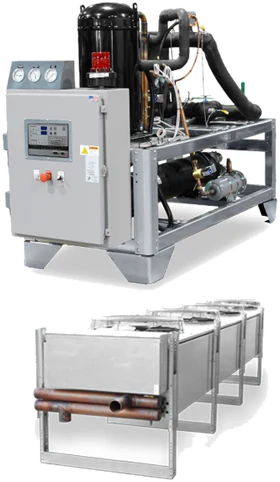
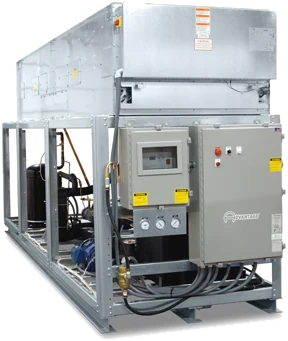
Reading a Thermal Care Part Number
On the portables the letter after the family is the condenser. NQA is air-cooled, NQW water-cooled and NQR remote air-cooled, and the EQ line does the same after its 4: EQ4A, EQ4W, EQ4R. The two digits that follow are nominal tons, and the unit page usually publishes a little more: the NQA10 is listed at 11 tons, the NQW40 at 43.
On the TSE the last letter counts circuits. TSEW is water-cooled and TSER remote air-cooled; S is one refrigeration circuit and D is two. A TSEW060S and a TSEW060D are both 60-ton-class chillers, published at 69 and 65 tons, but the D carries two independent circuits of two scroll compressors each, so it keeps running on one if the other trips.
On the TC the number is the frame and the letter the configuration. TCW is water-cooled, TCR remote air-cooled. The 300 and 350 frames are single-circuit, the 600 and 700 dual-circuit, and each frame covers a published range, 30 to 90 tons for the TCW300 for example. Within it the letter sets the configuration: TCW300C, E, J and M are published at 60, 70, 80 and 90 tons. KSEA numbers are nominal tons, and the two TCF models are the TCFW350A process chiller and the TCFW375 ice-rink chiller.






Replacing a Thermal Care Chiller
We do not sell Thermal Care equipment. We supply new Temptek chillers, and every Thermal Care part-number page names the Temptek unit we would put in its place: the same format, the smallest size that covers the published Thermal Care capacity, and a link to that unit's own page on this site. Both makers rate at 50°F leaving fluid, so the comparison is like for like: an NQ portable maps to a Temptek CG portable with the same condenser style, a TSE maps to a Temptek chilling module, water-cooled or remote, with the same number of circuits, a TC maps to a Temptek TTI central chiller or MA module, and a KSE maps to a dual-zone Temptek outdoor unit.
Two groups do not map one to one. The largest TC and TSE units, 200 tons and up, are beyond any single Temptek chiller, so their pages point to the add-on module range on our sister site, paired to the load. The TCFW375 is an ice-rink chiller rated at a 13°F set point, colder than anything in our range, so its page sends you to an application specialist. Thermal Care publishes its capacities at 50°F only; if your process runs colder, the unit you have makes less than its nameplate, and so will the replacement. Before quoting we ask for the nameplate model and serial, the set point the process actually runs at, the glycol type and mix, and the voltage.
Call and talk it through with an engineer: 1-805-484-2992
Specifications sourced from Thermal Care's published unit pages and series specification tables (thermalcare.com), September 2026. Thermal Care, Accuchiller and the series names shown are trademarks of their owner; referenced here for cross-reference only. Turbocor is a trademark of its owner. Confirm against the unit nameplate before ordering.
Before You Order
REPLACE • REFRIGERANT
Refrigerant Phase-Out
Older units in the field may still run R-22 or R-410A. What the refrigerant change means for service, retrofit and replacement.
+ Learn More
REPLACE • INSTALL
Swap-Out Checklist
Rigging, electrical, piping and start-up items to settle before the old chiller comes out of service.
+ Learn More
REPLACE • CONDITION
Signs You Need a New Chiller
Short cycling, rising amps, a tank that will not pull down: the symptoms that say the old unit is near the end.
+ Learn More