1-805-484-2992

Quotes - Sizing - Sales
Replacement unit for the Thermal Care KSE Series

KSE Series

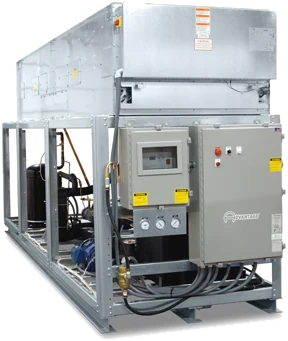
The whole chiller outside: Thermal Care's packaged outdoor units, 40 to 120 tons each on dual circuits, rated for -20 to 125°F ambient.

PRODUCT TYPE CAPACITY MODELS
Outdoor Chiller Outdoor Packaged 40 to 120 Tons 6

Specifications


Configuration & Size

Capacity:
40 to 120 Tons at 50°F
Models:
6 part numbers
Compressor:
Tandem scroll, 2 or 4
Pump Package:
96 to 288 GPM
Refrigerant:
R-454B, R-410A

Construction

  • Tandem scroll compressors, dual circuits
  • Microchannel condenser, VFD fans
  • Stainless brazed plate evaporators
  • Optional pump package and tank
  • Rated for -20 to 125°F ambient

Ratings

  • Rated at 50°F leaving coolant
  • 95°F ambient air
  • R-454B or R-410A
  • Power: 460/3/60 published

Specifications sourced from Thermal Care's published unit pages and series specification tables (thermalcare.com), September 2026. Thermal Care, Accuchiller and the series names shown are trademarks of their owner; referenced here for cross-reference only. Turbocor is a trademark of its owner. Confirm against the unit nameplate before ordering.

KSE Series Outdoor Packaged Chillers, 40 to 120 Tons

No Mechanical Room Required

Six models, two refrigeration circuits each. The KSEA040 to KSEA060 carry two scroll compressors and the KSEA080 to KSEA120 four, on dual circuits, with a microchannel air-cooled condenser, variable-speed condenser fans as standard and stainless steel brazed plate evaporators, on R-454B or R-410A.

Capacity is published at 50°F leaving coolant and 95°F ambient, from 40 tons on the KSEA040 to 120 tons on the KSEA120, with a 20 to 80°F set point range and an operating ambient of -20 to 125°F with no options.

The pumps and tank are a package option. Thermal Care offers standard-pressure pumping, 7.5 to 15 hp for 96 to 288 GPM at 39 to 62 PSI, a high-pressure package of 15 to 25 hp at 76 to 90 PSI, dedicated standby pumps, and an integral tank section that ships separately and pipes to the chiller.

Plants are built by combining units. Up to 12 refrigeration circuits combine into one system, which is where the series' 720-ton figure comes from: six of the 120-ton units.


scientist in blue gloves at a microscope in a white laboratory

Microchannel condenser, VFD fans, dual circuits and an optional pump-tank section, all on the pad.

Request a Quote

KSE Series Applications

Outdoor pad installation
Winter glycol loops
Winter glycol loops
Dual-circuit redundancy
Plant process water
Plant process water

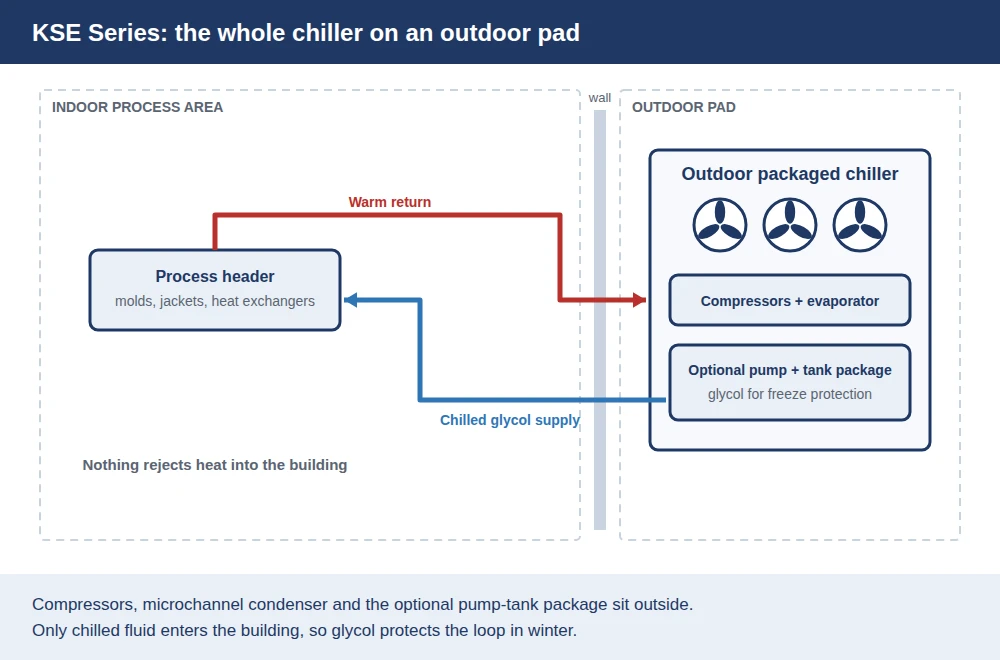
schematic of the KSE series circuit, showing where the process fluid and the condenser heat go

Outdoors Means Glycol

A KSE sits on a pad or a roof and sends chilled fluid into the building, so none of its heat stays inside and none of the plant floor is used. The price of that is winter: the unit and its piping see freezing weather, so the loop needs glycol at a concentration that protects it at the site's coldest night, even if the process runs at 50°F. The glycol type and mix guide explains how much glycol that takes and what it does to capacity.

Thermal Care's -20 to 125°F ambient rating covers most North American sites without options. At the hot end, check the clearances: a unit hemmed in by walls breathes its own exhaust and runs above its rating ambient on the days it is needed most.

Every part-number page below names the Temptek dual-zone outdoor packaged chiller we supply in its place, sized to cover the published 50°F capacity, so the two-circuit redundancy carries over.
Call and talk it through with an engineer: 1-805-484-2992

Before You Order a KSE Outdoor Chiller

No: the -20 to 125°F rating says the KSE itself will run in that weather without options, not that the fluid in its evaporator and piping will survive it. Freeze protection comes from the glycol concentration, and that is set by the coldest night at the site, even when the process runs warm. The usual failure is a loop filled for a mild winter, then a cold snap during a weekend shutdown with the pumps off. Settle the glycol mix before the size, because glycol takes something off capacity and the TTOACS unit we supply is selected with it.

About 10°F on water, judging by its figures: the standard package's 96 to 288 GPM works out to 2.4 GPM per ton across the 40 to 120-ton range. As a check, 500 x 288 x 10 equals the 1,440,000 BTU/hr of a 120-ton load. A process that runs a tighter rise, say 5°F, needs twice the flow, and the pumping is selected for that. The standard pumps deliver 39 to 62 PSI; the high-pressure package, 15 to 25 hp, delivers 76 to 90 PSI for long headers or high-drop equipment. Glycol needs somewhat higher flow to carry equal heat. Send the flow and pressure your existing pumps make, since the replacement's pumping is matched to them.

About 21% at both ends of the range: the TTOACS-50D-MZC-2P we supply for the 40-ton KSEA040 is rated 48.4 tons, and the TTOACS-150D-MZC-2P for the 120-ton KSEA120 is rated 145.8 tons. Both manufacturers rate at 50°F leaving fluid, so those tons compare directly. The headroom exists because the two makers' sizes do not land on each other, not because the KSE was undersized. Count it as margin for a hot afternoon, not as room to add load without a check. The replacement is dual-zone, so the two-circuit arrangement carries over.

With its variable-speed condenser fans, standard on the KSE: in cold air they slow so condensing pressure stays high enough for the expansion valves to feed. Without that, a chiller in a -20°F wind over-condenses and trips on low pressure at light winter load. Tell us the coldest ambient the unit runs in, and the replacement's low-ambient control is confirmed against it.

How the new unit will share the header and the controls with the KSE units that stay, because Thermal Care combines up to 12 refrigeration circuits, six two-circuit units, into one plant. A replacement that is larger then its neighbors will carry more of the load if it is sequenced the same way, so the lead-lag logic should know its real size. Check the header connection, whether the pumping is shared, and how the plant controller talks to each unit. Tell us how many units share the header and their model numbers, so the new one is set up to work with the rest.

Quote Request Form:

Questions?

1-805-484-2992

Quotes - Sizing - Sales