1-805-484-2992

Quotes - Sizing - Sales
Replacement unit for the G&D Fire & Ice Portable Series

Fire & Ice Portable Series

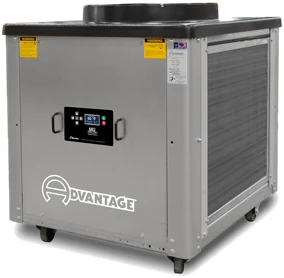
The harvest cart: a portable glycol chiller on casters, with a heater option and quick connects for four tanks at once.

PRODUCT TYPE CAPACITY MODELS
Portable Chiller Portable 3 and 7 HP 9

Specifications


Configuration & Size

Capacity:
3 and 7 HP
Models:
9 part numbers
Compressor:
3 or 7 HP
Process Flow:
25 to 40 GPM
Refrigerant:
R-448A, R-513A

Construction

  • Stainless housing on casters
  • Stainless reservoir, 30 to 50 gallons
  • Optional 6 to 25 kW heating element
  • Four brass quick-connect circuits
  • 20 ft hoses and 25 ft power cord

Ratings

  • Rated at 20, 30 and 40°F glycol
  • Heat/chill units at 30°F
  • Refrigerant R-448A or R-513A
  • Power: 230/1, 230/3, 460/3

Specifications sourced from G&D Chillers' published product pages, spec sheets and brochures (gdchillers.com), September 2026. G&D Chillers, Nano Chill, Micro Chill and Fire & Ice are trademarks of their owner; referenced here for cross-reference only. Confirm against the unit nameplate before ordering.

Fire & Ice Portable Chillers and Heat/Chill Units

One Cart, Four Tanks, Hot or Cold

Nine models on two compressor sizes. The CH-3 carries a 3 HP compressor on R-448A and the CH-7 a 7 HP compressor on R-513A. The plain CH-3 and CH-7 only chill; the models with a slash add an electric heating element of 6 to 25 kW, the number after the slash.

Cooling is published at 20, 30 and 40°F. The CH-3 makes 17,400 to 26,600 Btu/h and the CH-7 25,900 to 43,100 Btu/h in a 90°F ambient. The heater models are listed at a single cooling point, 30°F glycol, with the heating in Btu/h beside it.

It is built to move. Stainless housing, rubber-on-steel casters, a 30 to 50-gallon stainless reservoir, brass quick connects for up to four tanks, and a set of 20-foot glycol hoses with a 25-foot power cord.

The heater is the reason wineries buy it. The same cart that crash-cools a tank of white wine will warm a tank for malolactic fermentation or bring juice up to pitching temperature, without a second machine.


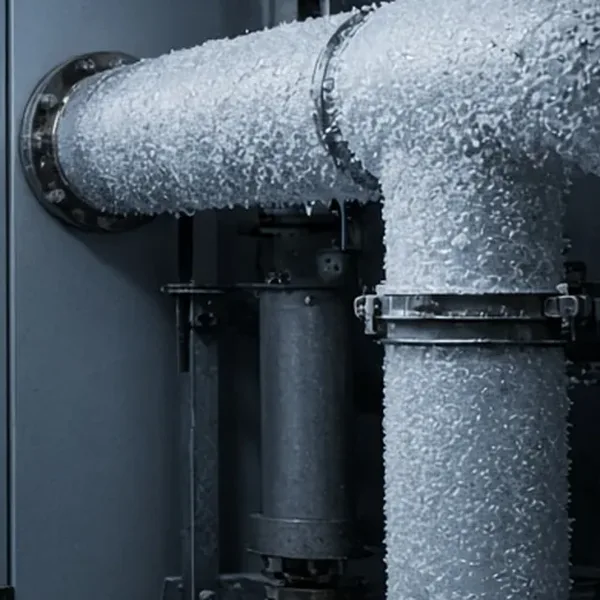
frost-covered insulated pipes and tanks in a low-temperature plant

Casters, quick connects and an optional heater: the chiller that follows the harvest round the cellar.

Request a Quote

Fire & Ice Portable Series Applications

Harvest and fermentation
Tank warming
Tank warming
Portable glycol cooling
Cider and juice temperature

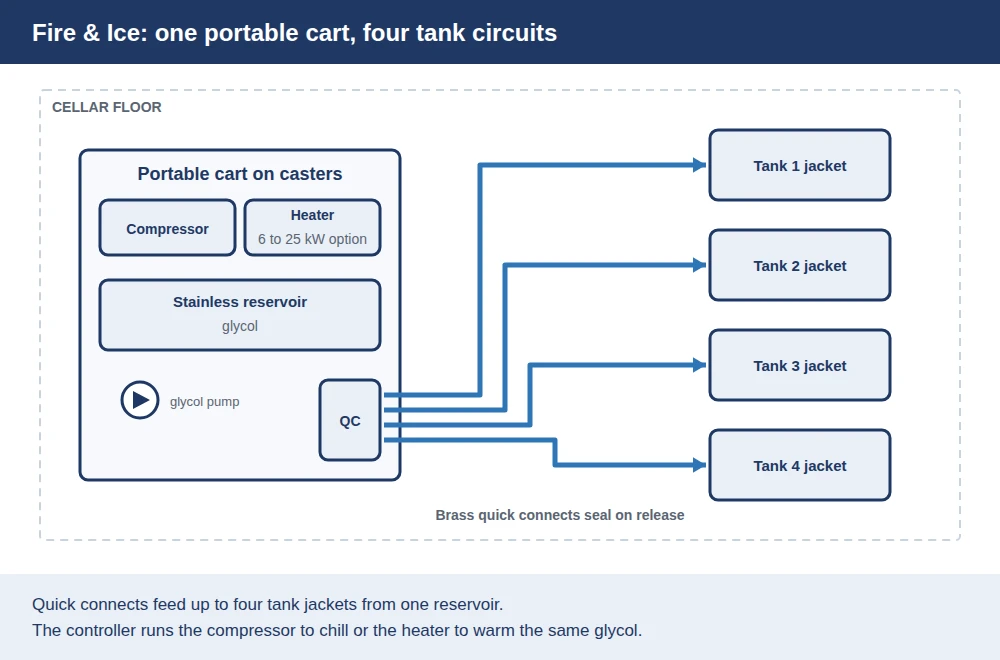
schematic of the Fire & Ice Portable series circuit, showing where the process fluid and the condenser heat go

Four Quick Connects, One Reservoir

The cart carries its own glycol. Four sets of brass quick connects feed up to four tank jackets at once, and the connectors seal on release, so a hose can move to the next tank without losing glycol. The controller then drives either the compressor or the heater to hold the reservoir at setpoint.

Four tanks share one small chiller. A CH-3 making about 21,800 Btu/h at 30°F will hold four tanks that are already cold, but it will not crash four at once. Treat the four ports as a convenience, and size from the heaviest single load in the cycle.

Each part-number page below names the Temptek portable we supply in its place, sized on cooling. The Temptek CG portable has no heater, so for the heat/chill models a separate tank heater or temperature control unit covers the heating side.
Call and talk it through with an engineer: 1-805-484-2992

Fire & Ice Carts: Heating, Power and Replacement

About an hour at full heater output, before losses. Wine is close enough to water that warming it takes roughly 8.3 Btu for each gallon and degree, so 1,000 gallons raised 10°F needs about 83,000 Btu against the 85,300 Btu/h G&D lists for the 25 kW element. The CH-3/6, at 20,500 Btu/h, needs four hours or more for the same job, and a 12.5 kW element at 42,700 Btu/h about two. On a 2,000-gallon tank the same 10°F takes about two hours on the 25 kW element and about four on a 12.5 kW element, such as the one on the CH-7/12.5. Uninsulated tanks in a cold cellar lose heat while they warm, so add time for that. When malolactic starts overlap on several tanks, the heater size usually decides the cart more than the compressor does.

The listing gives no reason, but the current explains it: at 460 V those two carts already draw 29 and 34 full load amps. The plain CH-3 draws 8 amps at 460 V against 16 on three-phase 230 V and 28 on single-phase, so the big elements on 230 V would roughly double their figures. Only the plain CH-3 and the CH-3/6 are listed on 230 V single-phase. Check the receptacle at every tank position the cart visits.

Only about 50 percent more, not the 130 percent the horsepower suggests. G&D publishes the CH-7 at 25,900 Btu/h at 20°F, about 2.2 tons, against 17,400, about 1.45 tons, for the CH-3. At 40°F the figures are 43,100 and 26,600, a 62 percent gap. The CH-7 also brings a 50-gallon reservoir in place of 30, the 1.5 HP pump and 450 lbs more operating weight to push across the cellar floor. Choose it when the heaviest single crash needs more than the CH-3's cold figure, not on horsepower. Its Temptek counterpart is the CGD-7.5A, rated 7.2 tons at 50°F.

It covers the chilling and leaves the 42,700 Btu/h of heating to a stand-alone tank heater or a temperature control unit. On cooling, the CG-4A is rated 4 tons at 50°F and about 1.6 tons at 20°F with the 0.40 multiplier Temptek publishes, against the 1.4 tons G&D publishes for the CH-3 at 20°F, so there is a small margin. Size the heater to the warm-up the cellar actually runs: if two tanks start malolactic on the same day, one heater of the 12.5 kW class will not keep the old schedule for both. The heater and the chiller then travel as two pieces of equipment.

On flow, yes, and flow is rarely the limit: split four ways, 40 GPM gives each jacket about 10 GPM. On the water formula, 10 GPM at a 10°F rise carries 50,000 Btu/h, more than the whole CH-7 makes at 40°F, so the refrigeration runs out long before the pump does. The CH-3's 0.75 HP pump at 25 GPM gives a little over 6 GPM per jacket. What the pump does notice is the 20-foot hoses and the quick connects, since its flow is published at 25 PSI. A far tank on a long hose gets less glycol than a near one unless the near valves are throttled back.

Quote Request Form:

Questions?

1-805-484-2992

Quotes - Sizing - Sales