1-805-484-2992

Quotes - Sizing - Sales
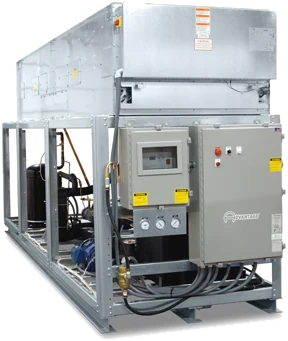
Replacement unit for the G&D LSX Ultra-Low Temp Series

LSX Ultra-Low Temp Series

Two-stage compressors for coolant at -30 to -50°F: G&D's LSX line for extraction and gas recovery.

PRODUCT TYPE CAPACITY MODELS
Low-Temp Chiller Outdoor Packaged 7 to 60 HP 7

Specifications


Configuration & Size

Capacity:
7 to 60 HP
Models:
7 part numbers
Compressor:
Two-stage reciprocating
Process Flow:
8.5 to 61.4 GPM
Refrigerant:
R-404A

Construction

  • Two-stage semi-hermetic compressors
  • Subcooler between stages
  • Heavily insulated stainless reservoir
  • Low-temperature coolant pump
  • CTS flange coolant connections

Ratings

  • Rated at -50, -40 and -30°F
  • 90°F ambient
  • Refrigerant R-404A
  • Power: 230/3 or 208-240/3, 460/3

Specifications sourced from G&D Chillers' published product pages, spec sheets and brochures (gdchillers.com), September 2026. G&D Chillers, Nano Chill, Micro Chill and Fire & Ice are trademarks of their owner; referenced here for cross-reference only. Confirm against the unit nameplate before ordering.

LSX Ultra-Low Temperature Chillers

Two-Stage Refrigeration to -50°F

Seven models on two-stage reciprocating compressors. G&D built the LSX for industrial gas recovery and essential-oil extraction. Each unit uses semi-hermetic two-stage compressors with a subcooler, one or two per unit, on R-404A, with a stainless coolant reservoir and a low-temperature coolant pump.

Capacity is published at -50, -40 and -30°F coolant. The range runs from 15,300 Btu/h at -50°F on the GD-7H-1LC to 195,200 Btu/h at -30°F on the GD-60H-2LC, in a 90°F ambient. G&D describes the line as holding process fluid down to -60°F.

Capacity falls fast with temperature. Every LSX unit loses roughly 40 to 45 percent of its -30°F capacity by -50°F. The same unit is a very different machine at the two ends of its range.

This is not glycol duty. At these temperatures the coolant is a low-temperature heat-transfer fluid, and the pump, seals and hoses have to be rated for it.


hydraulic forging press with glowing hot metal in a dark factory

Two-stage compressors, a heavily insulated tank and a pump chosen for cold, viscous coolant.

Request a Quote

LSX Ultra-Low Temp Series Applications

Ultra-low temperature
Solvent and gas recovery
Extraction condensers
Botanical extraction

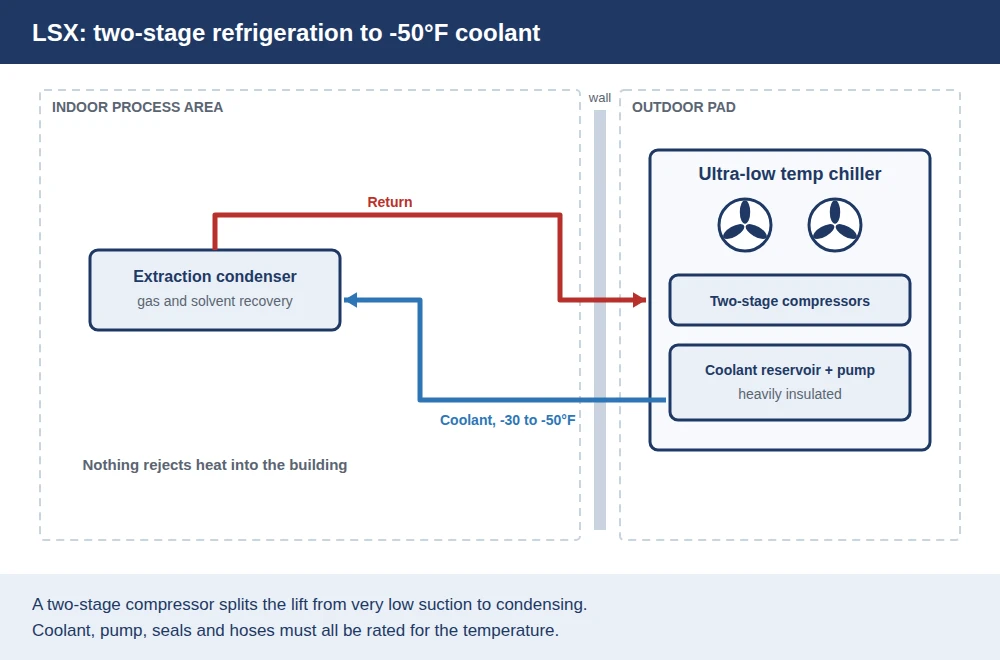
schematic of the LSX Ultra-Low Temp series circuit, showing where the process fluid and the condenser heat go

Why Two Stages

A single-stage compressor pumping from -60°F suction up to condensing on a hot day faces a pressure ratio it cannot hold efficiently. A two-stage compressor splits that lift, and the subcooler between the stages cools the liquid refrigerant so more of it evaporates usefully. That is what lets an air-cooled package reach -50°F at all.

Nothing in our range reaches these temperatures. The Temptek and sister-site chillers are rated for leaving fluid no colder than about 20°F, so the LSX part-number pages do not name a like-for-like unit. If you are replacing an LSX, or deciding whether the process really needs -50°F, talk to an application specialist; a warmer condensing stage sometimes changes the answer.
Call and talk it through with an engineer: 1-805-484-2992

LSX Ultra-Low Temp: What to Know Below -30°F

About 5 tons: G&D publishes 60,500 Btu/h at -40°F coolant in a 90°F ambient. That is roughly a quarter ton per compressor horsepower, and at -50°F it falls under a fifth; the GD-7H-1LC makes 15,300 Btu/h there, about 1.3 tons from 7 HP. At -30°F the GD-20H-2LC makes about 6.6 tons and at -50°F about 3.8. Even the largest unit is a mid-size machine in tonnage terms: the GD-60H-2LC makes about 16 tons at -30°F from two 30 HP compressors, and less at the colder points. Sizing an extraction condenser on horsepower leaves the process badly short. Start from the load in Btu/h at the coldest coolant temperature the process needs, then pick the unit.

Only a few degrees at full load. On the water formula, the GD-60H-2LC's 195,200 Btu/h at -30°F over 61.4 GPM is a rise of about 6.4°F, and the GD-7H-1LC's 15,300 Btu/h at -50°F over 8.5 GPM is under 4°F. Low-temperature heat-transfer fluids carry less heat per gallon than water and thicken as they cool, so the real rise is somewhat higher and the pump works harder than these figures suggest. Design the condenser coil around a small rise and the pump's 25 PSI.

No. More glycol lowers the freeze point of the fluid but does nothing for the compressor, and a single-stage unit can not hold the lift from suction colder than -30°F to an air-cooled condenser on a hot day. Every Temptek unit we supply is rated for leaving fluid above zero, which is why the LSX part-number pages name no match. Where a process has stages at different temperatures, it is worth separating them: a solvent or vapor condenser that can run warmer may come off the ultra-low loop entirely, leaving a smaller LSX-type duty. Send the temperature and load at each stage.

No figure is published at -60°F, so that rating is confirmed on request before any unit is chosen. G&D's capacity tables stop at -50°F, and we do not project a number below the last published point, since compressors near the bottom of their range seldom behave the way the warmer points suggest. The published data ends where the GD-20H-2LC makes 45,800 Btu/h and the GD-7H-1LC 15,300. If the process truly needs -60°F, send the load in Btu/h at that temperature, the coolant and the flow, and check that the coolant, seals and hoses are all rated that cold. It is also worth asking whether -50°F would do, because that is the coldest point with a published rating.

Quote Request Form:

Questions?

1-805-484-2992

Quotes - Sizing - Sales