
1-805-484-2992
Quotes - Sizing - Sales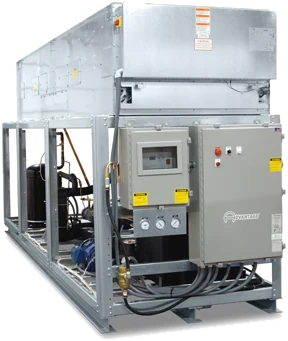
Single Stage Series
One compressor, one glycol tank, one pump: G&D's small cellar chillers, 1.5 to 13.5 HP, sold as the Nano Chill and Micro Chill.
| PRODUCT | TYPE | CAPACITY | MODELS |
|---|---|---|---|
| Glycol Chiller | Outdoor Packaged | 1.1 to 9.6 Tons | 7 |
Specifications
Configuration & Size
Capacity:
1.1 to 9.6 Tons at 40°F
Models:
7 part numbers
Compressor:
One per unit
Process Flow:
20 to 65 GPM
Refrigerant:
R-448A
Construction
- Powder-coated steel frame, aluminum housing
- Brazed-plate evaporator, stainless plates
- Insulated stainless glycol reservoir
- Glycol pump and bypass valve on board
- ETL 508A listed control panel
Specifications sourced from G&D Chillers' published product pages, spec sheets and brochures (gdchillers.com), September 2026. G&D Chillers, Nano Chill, Micro Chill and Fire & Ice are trademarks of their owner; referenced here for cross-reference only. Confirm against the unit nameplate before ordering.
Single Stage Glycol Chillers, 1.5 to 13.5 HP
The Small Brewery and Winery Chiller
Seven models, one refrigeration circuit each. G&D calls the 1.5 and 2 HP units the Nano Chill and the 3 to 13.5 HP units the Micro Chill. Each is a complete outdoor-rated package: compressor, brazed-plate evaporator, air-cooled condenser, an insulated stainless glycol reservoir and a glycol pump, on R-448A.
Capacity is published at 20, 30 and 40°F leaving glycol in a 90°F ambient. At 40°F the range runs from 13,500 Btu/h on the GD-1.5H to 115,000 Btu/h on the GD-13.5H, roughly 1.1 to 9.6 tons; at 20°F the same units make about two-thirds of that.
Power depends on size. The 1.5 to 5 HP units are listed on 230 V single-phase, the 3 HP and up on 460 V three-phase, and every size on 230 V three-phase. The pump and tank grow with the compressor: an 18-gallon tank and 20 GPM on the smallest, up to 110 gallons on the largest.
One circuit means no redundancy. If the compressor stops, the cellar warms. For a brewery where a lost batch costs more than the chiller, the two-compressor Multi Stage units are the step up.
Packaged, outdoor-rated and on glycol from the start: the cellar chiller for a handful of fermenters.
Request a QuoteSingle Stage Series Applications




Outside the Building, Glycol to the Tanks
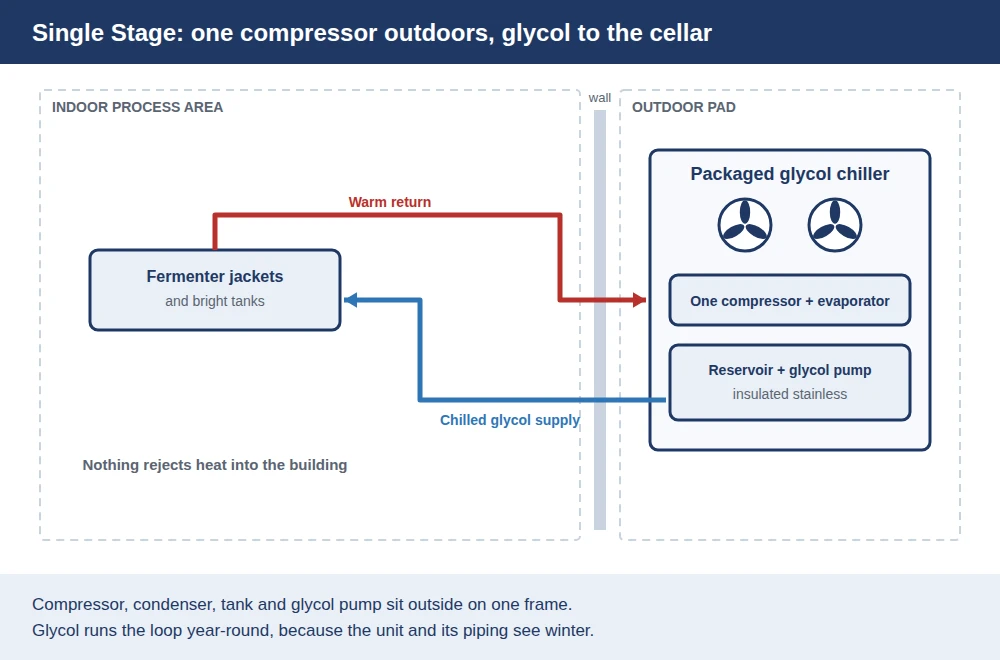
A Single Stage unit sits outdoors and sends glycol through the wall to the fermenter jackets. That keeps the condenser heat out of the cellar, which is the point of an outdoor package, and it means the loop has to carry glycol whatever the setpoint, because the unit and its piping see winter.
Size it at the temperture the glycol actually runs. A brewery that crash-cools to 32°F usualy runs its glycol near 25°F, and at that point a GD-5H is making something like 37,000 Btu/h, not the 50,600 on its 40°F line. The crash load, not the steady fermentation load, is usually the one that decides the size. The glycol chiller sizing guide walks through it tank by tank.
Every part-number page below names the unit we supply in its place. The three smallest, 1.5 to 3 HP, point to an indoor Temptek CG portable, because Temptek's outdoor range starts at 5 tons. Each pick is sized to cover the G&D unit at 20°F, its coldest published point.
Call and talk it through with an engineer: 1-805-484-2992