1-805-484-2992

Quotes - Sizing - Sales
Replacement unit for the G&D Expansion Module Series

Expansion Module Series

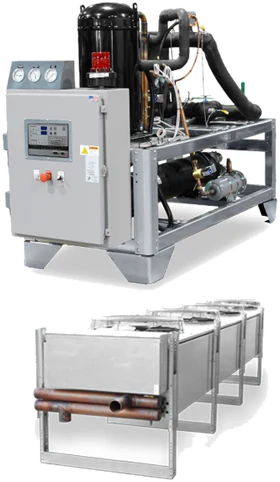
Refrigeration without the plant: G&D's Expansion Modules add 5 to 50 HP of chilling to an existing tank and pump.

PRODUCT TYPE CAPACITY MODELS
Chiller Module Expansion Module 5 to 50 HP 8

Specifications


Configuration & Size

Capacity:
5 to 50 HP
Models:
8 part numbers
Compressor:
One or two per unit
Tank & Pumps:
Uses the base unit's
Refrigerant:
R-404A, R-448A

Construction

  • Complete refrigeration circuit
  • Brazed-plate evaporator
  • Circulation pump for the evaporator
  • No reservoir, no process pump
  • Supply and return ball valves

Ratings

  • Rated at 20, 30 and 40°F glycol
  • 90°F ambient
  • Refrigerant R-404A or R-448A
  • Power: 230/3, 460/3 (published units)

Specifications sourced from G&D Chillers' published product pages, spec sheets and brochures (gdchillers.com), September 2026. G&D Chillers, Nano Chill, Micro Chill and Fire & Ice are trademarks of their owner; referenced here for cross-reference only. Confirm against the unit nameplate before ordering.

Expansion Modules, 5 to 50 HP

More Capacity on the Same Loop

Eight modules, refrigeration only. An Expansion Module has the compressor, evaporator, air-cooled condenser and a small circulation pump, but no reservoir and no process pump. It pulls glycol from an existing tank, chills it and returns it.

Three modules have readable sheets. G&D publishes the GD-10H-EM at 64,218 to 96,495 Btu/h and the GD-13.5H-EM at 77,911 to 114,193 Btu/h across 20 to 40°F, both on R-404A, and the GD-50H-1C-EM at 315,000 to 468,000 Btu/h on R-448A, all in a 90°F ambient.

The rest are published as artwork. The 5, 7, 20, 27 and 35 HP module sheets cannot be read as text, so those pages carry the product-page figures only: footprint, circulation pump and connection size.

Modules suit a plant that already works. If the tank and pump are sound and only the refrigeration is short, a module is the cheapest capacity there is. If the pump is already at its limit, a module adds nothing the loop can deliver.


rotating drum discharging grapes into a hopper at a winery crush

Compressor, evaporator, condenser and a circulation pump: capacity that plugs into the tank you already have.

Request a Quote

Expansion Module Series Applications

Adding plant capacity
Existing pump-tank stations
Staged refrigeration
Brewery expansions
Brewery expansions

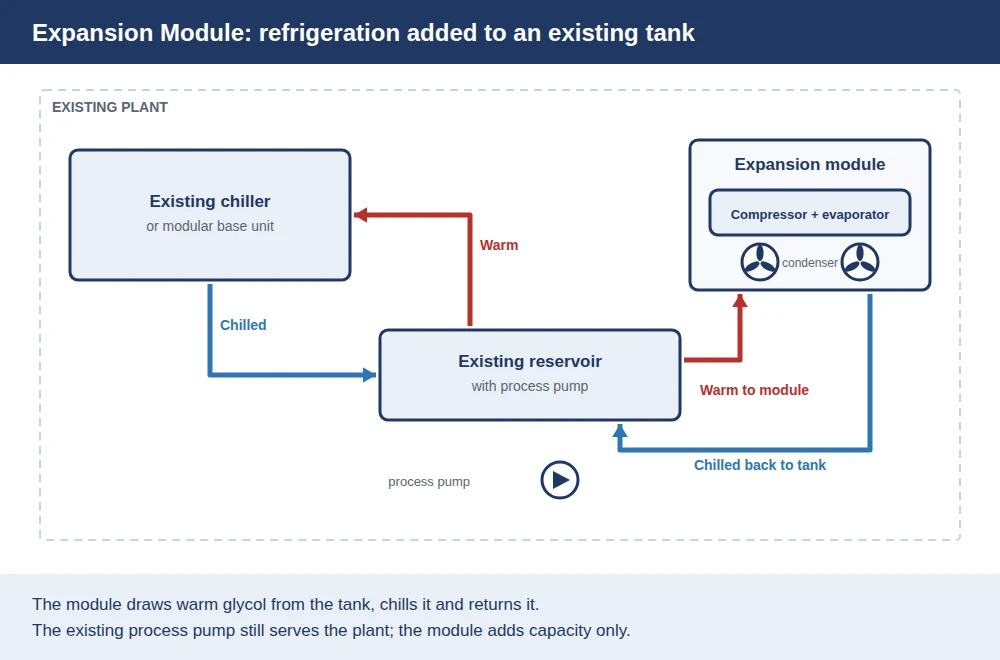
schematic of the Expansion Module series circuit, showing where the process fluid and the condenser heat go

Tied to the Base Tank

An Expansion Module sits beside the base unit and pipes to its reservoir: supply from the warm side of the tank, return to the cold side. Its own circulation pump moves glycol through its evaporator; the base unit's process pump still serves the plant. The module adds refrigeration, and nothing else.

Two things decide whether a module helps. The reservoir must be large enough that the base unit and the modules are not all chasing the same few gallons, and the process pump must already deliver the flow the plant needs at the new load. Check both before adding refrigeration.

Each part-number page below names the Temptek chilling module we supply in its place: a Temptek MA module, which carries its refrigeration on a frame and puts its condenser outdoors, sized to cover the module's published or sibling-size capacity.
Call and talk it through with an engineer: 1-805-484-2992

G&D Expansion Modules: Before You Add Capacity

About 26 tons, from the 315,000 Btu/h G&D publishes at 20°F in a 90°F ambient. The 468,000 Btu/h figure, roughly 39 tons, belongs to 40°F glycol, so a brewery loop running in the 20s gets about two-thirds of the headline number. The two R-404A modules behave the same way: the GD-10H-EM goes from about 8 tons at 40°F to 5.4 at 20°F, and the GD-13.5H-EM from 9.5 to 6.5. The usual error is adding a module's 40°F figure to the base unit's 20°F capacity, then wondering why the crash schedule slips.

Give them slightly different setpoints, so one machine leads and the other starts only when the tank keeps warming. Both read the same reservoir, and with identical setpoints they start and stop together, short-cycling on light loads and overshooting after a crash. Let the base unit lead, since its process pump runs anyway, and set the module a little warmer so it picks up the peaks. If run hours drift far apart, hand the lead to the module for a season.

We confirm the rating on request rather than estimate it, because G&D publishes no readable capacity for five of the eight modules, the 27 and 35 HP sizes among them. Horsepower is no substitute: the three readable sheets loose about a third of their 40°F capacity by 20°F glycol, so a figure guessed from compressor size, at an unknown rating point, can miss by more than the margin the selection is meant to hold. Send the module nameplate, the base unit's setpoint and, where possible, a measured load on the loop: supply and return temperatures with the flow, which give Btu/h at 500 x GPM x delta-T, a little less on glycol. The Temptek MA module on each part-number page is then checked against that figure at your setpoint before the order.

The condenser becomes a separate outdoor unit. The G&D module carries its own air-cooled condenser, while the Temptek MA-30-RC-C we supply in its place keeps compressors and evaporator on one frame and rejects heat through a remote condenser on a pad or roof. That brings field-run refrigerant lines between the two and, where the G&D module stood indoors, condenser heat that no longer enters the building. On capacity, the MA-30-RC-C is rated 30 tons at 50°F and about 12 tons at 20°F once Temptek's 0.40 multiplier is applied, roughly 12 percent above the GD-20H's published 10.7 tons at that temperature. Send the line route and the height difference with the quote request.

Quote Request Form:

Questions?

1-805-484-2992

Quotes - Sizing - Sales