
1-805-484-2992
Quotes - Sizing - Sales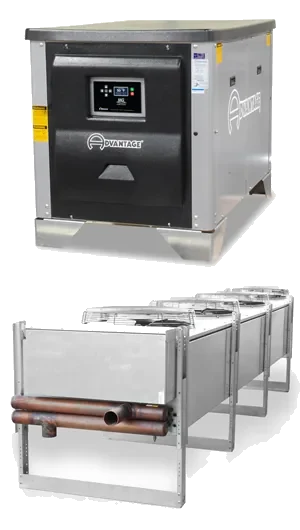
ES / EST Split-System Scroll Series
The compressor and evaporator indoors, the condenser coil and fans outdoors: Drake's split-system scroll chillers, 1.5 to 120 hp.
| PRODUCT | TYPE | CAPACITY | MODELS |
|---|---|---|---|
| Split-System Chiller | Split-System Air-Cooled | 1.5 to 120 HP | 79 |
Specifications
Configuration & Size
Horsepower:
1.5 to 120 hp
Models:
79 part numbers
Capacity:
1.3 to 133 tons at 50-55°F
Condenser:
Remote, air-cooled
Refrigerant:
R407C, R404A
Construction
- Copeland scroll, digital or tandem
- Indoor evaporator section
- Outdoor CS condenser section
- Stainless brazed plate evaporator
- EST models with a tank
Specifications sourced from Drake Refrigeration's published product-line pages and per-model specification sheets (drakechillers.com), September 2026. Drake Refrigeration and the model names shown are trademarks of their owner; Copeland is a trademark of its owner; referenced here for cross-reference only. Drake marks its sheets for reference only. Confirm against the unit nameplate before ordering.
ES and EST Split-System Scroll Chillers, 1.5 to 120 HP
Indoor Chiller, Outdoor Condenser
Seventy-nine models across five product lines. Single-circuit scroll, digital scroll, dual-circuit scroll and digital scroll, and tandem scroll units from 1.5 to 120 hp; thirty are EST units with a tank.
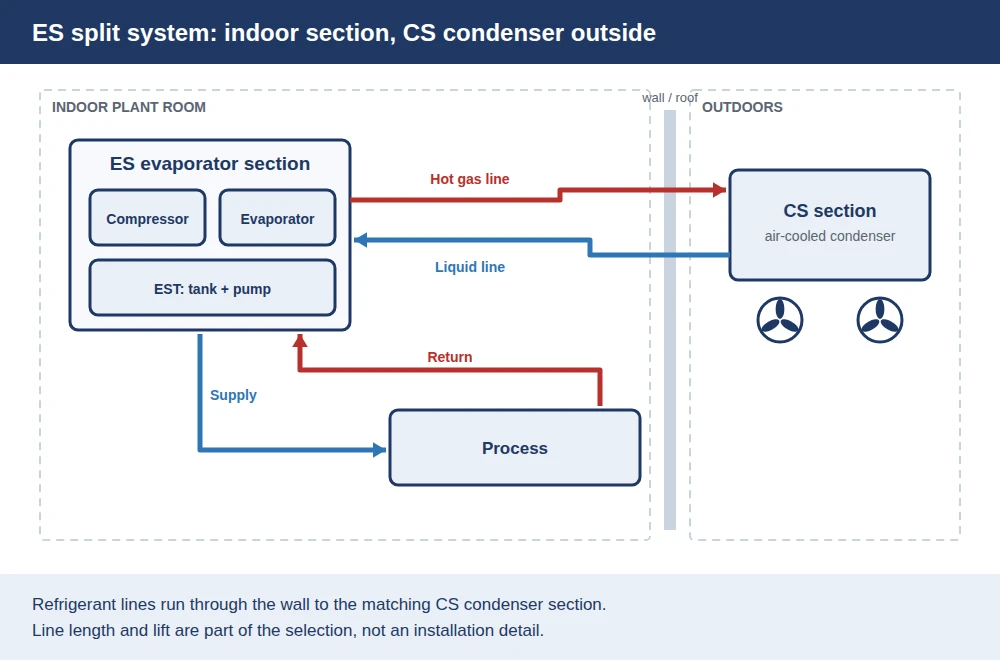
Each ships in two sections. The ES evaporator section holds the compressors, evaporator and controls indoors; a CS condenser section of the same size goes outdoors. The ES96D evaporator section is listed at 65 x 30 x 39 inches and its CS96D condenser section at 75 x 34 x 52-1/4 inches.
Capacity is tabulated against ambient. The ES96D sheet lists 6.9 tons at 35°F up to 12.5 tons at 65°F leaving fluid in a 95°F ambient on R407C, the same figures as the packaged PACT96D shifted five degrees.
Drake lists the applications. Medical, brewery, laboratory, blow molding, dairy and food processing are the uses Drake names for its split systems.
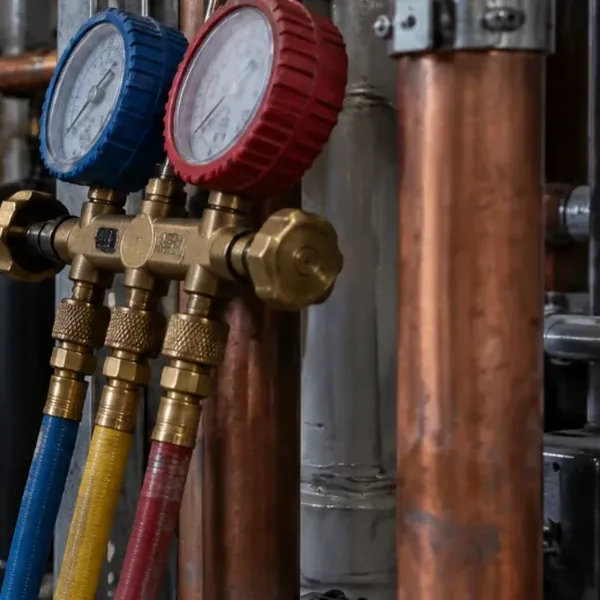
The heat leaves through a pair of refrigerant lines to a condenser outdoors; nothing is rejected into the room.
Request a QuoteES / EST Split-System Scroll Series Applications




The Line Run Is Part of the Replacement
A split system avoids the room heat of a packaged air-cooled unit and the tower of a water-cooled one; its cost is the refrigerant piping between the sections, sized for the length and lift. Drake lists the discharge and liquid connection sizes on each sheet. A replacement is the time to decide whether the old condenser section and lines stay, and they only can if they suit the new unit's refrigerant.
The indoor vs outdoor installation guide compares the arrangements.
Every part-number page below names the Temptek unit we supply in its place, matched at 50°F leaving fluid and 95°F ambient: a Temptek CG-ARC chiller with a remote condenser to 36.7 tons, and an MA chilling module with a remote condenser above.
Call and talk it through with an engineer: 1-805-484-2992