1-805-484-2992

Quotes - Sizing - Sales
Replacement unit for the PRO Refrigeration ChilStar Series

ChilStar Series

PRO's ChilStar: a 100-gallon glycol chiller from 3 to 13.5 hp, in a NEMA 4 cabinet for indoor or outdoor duty.

PRODUCT TYPE CAPACITY MODELS
Glycol Chiller Packaged, Air-Cooled 3 to 13.5 HP 4

Specifications


Configuration & Size

Capacity:
27,200 to 102,300 Btu/h at 30°F
Models:
4 part numbers
Compressor:
3 to 13.5 hp
Pump:
1 to 2 hp circulation
Tank:
100 gallons

Construction

  • Reciprocating and scroll compressors
  • Brazed plate heat exchanger
  • Stainless centrifugal pump
  • HDPE insulated tank
  • NEMA 4 enclosure, UL 508A panel

Ratings

  • Rated at 20 to 35°F glycol
  • 90°F and 100°F ambient
  • R448A / R449A / R454C
  • 230 or 460 V

Specifications sourced from PRO Refrigeration's published chiller data sheets, series one-sheets and legacy specification tables (prochiller.com), October 2026. PRO Refrigeration, PRO Chiller Systems, Chill&Flow, ChilStar, PRO4, V Piston, V-Scroll, Revolution, PROGreen and PROElliot are trademarks of their owner; referenced here for cross-reference only. PRO publishes these as estimated capacities. Confirm against the unit nameplate before ordering.

ChilStar Series, 3 to 13.5 HP

One Tank Size, Four Compressors

Four models on a 100-gallon tank. The PE103BCR8100-A-V and PE105BCR8100-A-V are 3 and 5 hp in a 55 x 38 x 68-inch frame; the PE110BCR8100-A-V and PE114F3R8100-A-V are 9 and 13.5 hp in a 72 x 46 x 82-inch frame.

Capacity at the glycol temperature. From 27,200 Btu/h at 30°F on the 3 hp unit to 102,300 Btu/h on the 13.5 hp, at 90°F ambient, with 20, 25 and 35°F figures and a 100°F ambient column on each sheet.

One pump. A single stainless centrifugal circulation pump of 1 or 2 hp serves the loop; PRO lists no separate process pump on the ChilStar.

Built for outdoors. A coated welded steel frame, galvanized housing and NEMA 4 electrical enclosure, with an ETL/UL 508A panel.


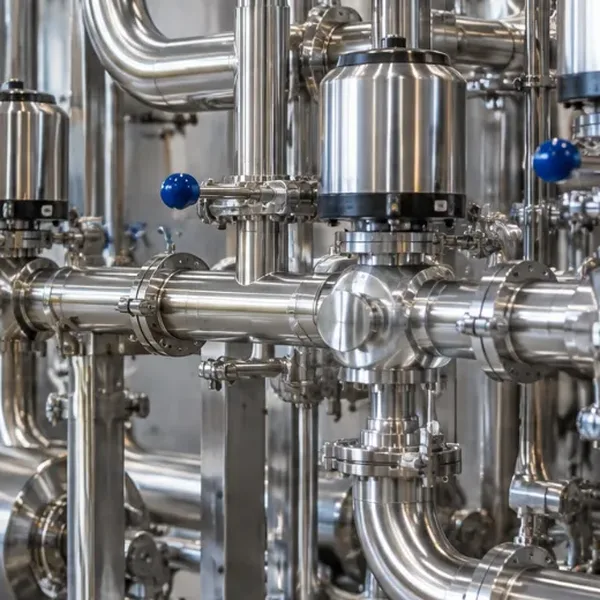
a polished stainless piping manifold with valves

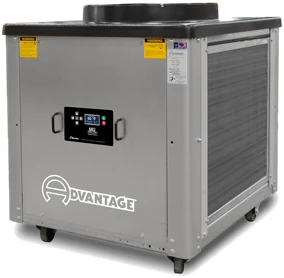
Compressor, brazed plate exchanger, a 100-gallon insulated tank and a stainless pump on a welded frame.

Request a Quote

ChilStar Series Applications

Brewery fermentation
Winery tank jackets
Winery tank jackets
Dairy cooling
Dairy cooling
Outdoor pads
Outdoor pads

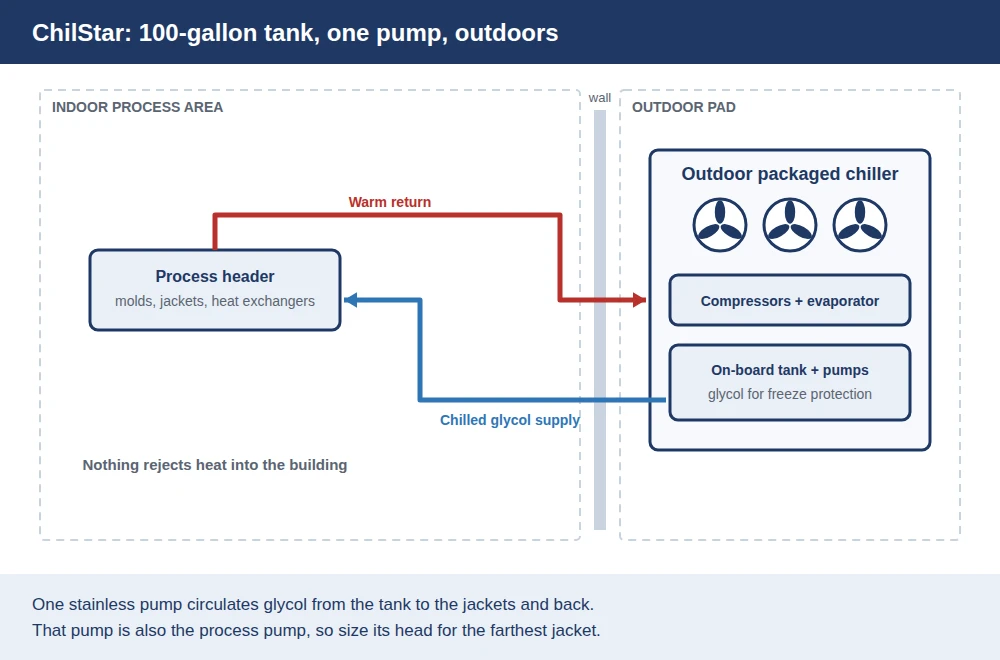
schematic of the ChilStar series circuit, showing where the process fluid and the condenser heat go

One Pump Means One Loop

The ChilStar circulates glycol from its tank with one pump. On a brewery with jacketed fermenters and a bright tank or two, that pump is also the process pump, so its head has to cover the farthest jacket. The glycol type and mix guide covers the mix, and the leaving fluid temperature guide the capacity at glycol temperatures.

Every part-number page below names the Temptek unit we supply in its place, sized from PRO's 30°F figure on Temptek's published multiplier: a Temptek unit makes 0.60 of its 50°F rating at a 30°F set point, so the pick is the PRO figure divided by 0.60.
Call and talk it through with an engineer: 1-805-484-2992

PRO ChilStar: What to Know Before Sizing

Yes for today's load, but with almost nothing to spare. On PRO's 90°F-ambient sheet the 13.5 hp PE114F3R8100-A-V makes 102,300 Btu/h, 8.53 tons, with 30°F glycol, which calls for 14.21 tons of 50°F rating against the 14.4 tons the TTOACS-15S-CG-1P carries. Worked back to 30°F, that unit makes about 103,680 Btu/h, roughly 1,400 Btu/h more than the ChilStar it replaces. The same pick behind a 9 hp PE110BCR8100-A-V leaves about 20,000 Btu/h spare. The mistake we see is a brewery that has outgrown its 13.5 hp unit, with tanks warming partway through a crash, asking for a like-for-like swap. If the old unit already runs without a break on brew days, give us the fermenter count and crash schedule, and the selection moves up a size instead of copying a figure that was already too small.

Between 18 and 28 percent on the two models whose 100°F figures we quote, and the larger frame loses more. The 5 hp PE105BCR8100-A-V goes from 38,800 to 31,700 Btu/h at 30°F glycol, 3.23 tons down to 2.64, when the air rises from 90 to 100°F. The 9 hp PE110BCR8100-A-V falls from 83,340 to 60,290 Btu/h, a loss of about 1.9 tons. A ChilStar on a sun-baked pad, or beside a wall that throws its own discharge air back at the coil, lives in the hotter column for much of the summer. The symptom is tanks that crash on schedule in spring and run long in July. Tell us which column matches your design day so the replacement is picked from the right number.

The ChilStar's single 1 or 2 hp circulation pump also delivers glycol to every jacket, so a replacement is judged on the worst branch, not on the tank loop. Where the last fermenter sits at the end of a long header or up on a mezzanine, the old pump may have been working near the end of its curve, and that tank is often the one that never quite holds set point while the near tanks are fine. Before we quote, measure or estimate the pipe length and rise to that farthest jacket, and count how many jackets can call at once. If the single-pump layout was already marginal, say so, and the pumping is specified around the loop rather then repeating the old limit.

Going from the 5 hp to the 9 hp ChilStar adds about 1,000 lbs of operating weight and drops the single-phase option. The 3 and 5 hp units weigh 1,700 to 1,800 lbs operating and can run on 230 V single-phase; the 9 and 13.5 hp units weigh 2,800 lbs and are three-phase only. Plan the lift for the unit coming out as well as the one going in. On the small frame, note that the 3 hp maps to the CG-4A portable, while the ChilStar was built for outdoor duty in a NEMA 4 cabinet; if yours sits outside, tell us.

Quote Request Form:

Questions?

1-805-484-2992

Quotes - Sizing - Sales